Latest Discussions
- Godfall | Game Review

With the release of the PS4 Version as well as the most recent Lightbringer update, Godfall remains a solid ARPG for those who can temper their expectations for a stellar story.
Godfall takes place on world of Aperion, and you play as Orin, one of the last Valorian Knights. They are warriors who are able to wield immense power channeled through Valorplates, specialized armors that are essentially different “builds” or classes. Orin will travel to various regions in Aperion in search of powerful allies while doing battle with the lackeys of Macros, his brother who betrayed him and all of Valorian Knights in pursuit to become godlike using a dangerous ritual called the Rites Of Ascension. Being one of the rumored Playstation Plus free titles for the month of December, I thought now would be an appropriate time to touch on Godfall seeing as there may hopefully be an influx of new players. I say hopefully because Godfall is sort of a mixed bag, and I think might have a bit more appeal now as opposed to its initial release. Mileage may vary for players depending on the what they are ultimately hoping to expect from the game.
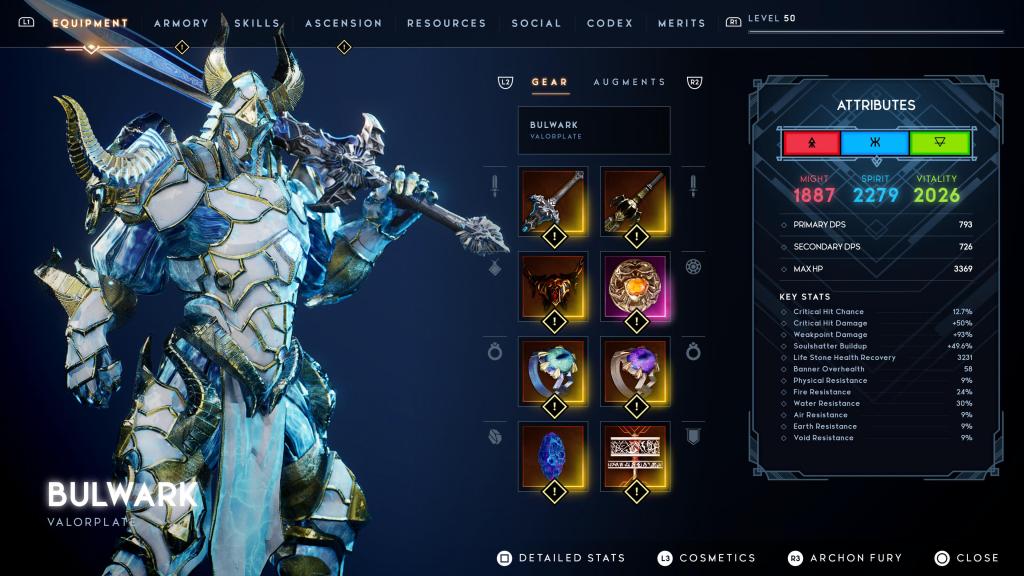
This build carried me through the Ascended Tower Of Trials. Min/Maxers will be delighted with getting the most out of all these numbers and specs Combat is really the strongest element of the game. Each Valorplate has a specific build in mind, which can be fully realized once you start investing in some abilities to round out your skillset. The most efficient method of destruction is to build up Breach damage, a bar under the enemy Health bar, and doing so allows you to deal massive damage, even moreso if you target enemies weak points. The two skills you will be using and abusing will be your Northern and Southern Technique. One applies heavy damage while the other applies heavy Breach damage. Utilizing these in tandem with your light attacks and heavy attacks will allow you to dispatch enemies quickly. Polarity attacks are another aspect that makes it worthwhile to actually switch up your weapons. Once your gauge is built up, swapping to your 2nd weapon will let out a shockwave of damage, and provide a damage buff. Let’s not forget your shield that is of course useful for blocking, also serves as an awesome Captain America-esque weapon that can be thrown and is very satisfying knocking enemies on their asses. To cap it off, you can perform an Archon Fury technique that is unique to each Valorplate, and each technique is like a hallmark of the Valorplate itself, usually providing bonuses that enhance its features such as adding bleed damage to each hit or critical hit rates/damage.
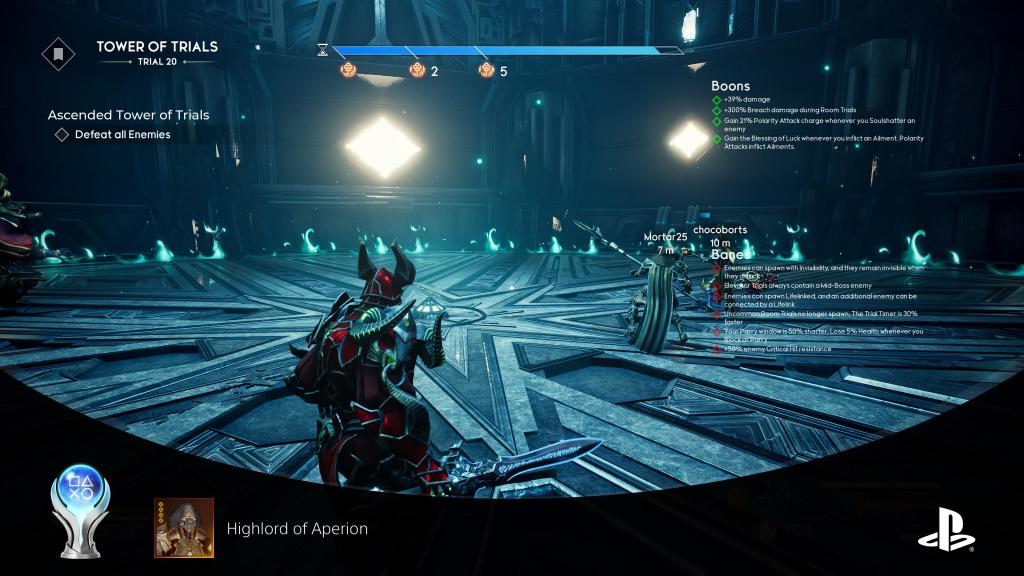
Dreamstones will be your method of powering up initially in your post game endeavors, and they essentially are condensed missions with certain modifiers. The interesting thing is that you can also modify the rewards they give you, allowing you to tailor them to your current gear needs or to find something to compliment your build. They are available early on in the post game, however they can grow increasingly challenging. The toughest challenge in the game (pre-Lightbringer, in my opinion) is the Ascended Tower Of Trials. You will be familiar with the Tower Of Trials because it essentially is an elevator style gauntlet that you visit during the main campaign as well. You experience a much watered down version initially, as it “challenges you” to prove you are worthy to visit other realms. You will eventually gain access to the Ascended version which is the real deal. As you progress you can choose the boons to apply to your team, as well as the curses that will hinder you. It may seem tantalizing to pick a curse that offers a better chance of loot and rewards, but doing so puts you and your team at a greater risk. Do so at your own peril, as losing a team mate can turn the tides horribly against you. If you have great team chemistry than choosing tough curses can be beneficial in the long run, but if you are running with a group of random players I’d stay the course with lighter ones and pick boons that focus on recharging rates of your abilities, as well as boosting defenses and status buildup. Status effects can be a massive lifesaver in this mode too, do not underestimate bleed, poison, etc.
Everything performs smoothly and once you get a rhythm in combat based on your playstyle and weapons, the synergy between your weapons and techniques really begins to shine. Add in bonuses from your weapons and gear, and you can become a monster provided you are properly utilizing your Valorplate to its full potential. Weapons feel weighty and you can feel the might behind your swings. This is accented with the Dualsense, so I’m not sure how much of this experience will be lost upon the players that might be playing this title on the PS4 version. I’ve only played the PS5 version so I can’t comment on the performance of the PS4, but I’d expect a visual downgrade as well as some performance hits. Combat really just flowed on the next gen consoles so hopefully they were able to maintain this as much as possible. You might be wondering why I’ve been emphasizing combat and gameplay, and to put it blunt the story is very light. It’s a story about saving the realms from a power hungry individual who happens to be your relative. Yes, it’s a trope and storyline that has been used and abused, but for what it’s worth, it holds up enough to get you from point A to point B.
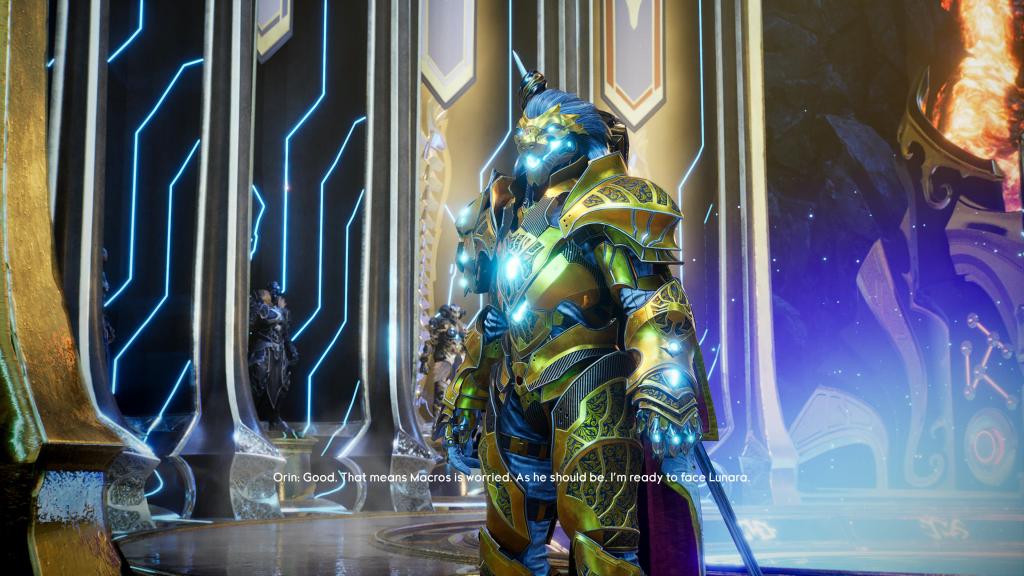
The biggest shame perhaps is that Godfall features a beautiful world that seems to be begging for the player to poke and prod at it in hopes of being rewarded with knowledge, story, and lore. However, this is where it falls flat. Don’t get me wrong, this isn’t the only issue. The lack of meaningful and varied endgame content also drags out what is your usual loop of “do missions -> get better gear that hopefully compliments your build -> do harder mission”. While the most recent update, Lightbringer, adds a bit of variety to your slaughtering, I feel the biggest issue for myself was the game didn’t give me a reason to love the world I was fighting to save. Two other looter games, Destiny and Borderlands, have excelled in this regard. Destiny and Destiny 2 took a while to really get going, but there is plenty of scannable objects and items that can provide even the smallest insight into the minds and hearts of the characters that fill up the game’s world, or the reason why certain areas are the way they are. Borderlands is very similar but goes about it with a slightly different approach, using humor and crudeness that fits well with the over-the-top characters and environment. Godfall doesn’t have any of that, and it’s apparent after a few missions.
If you are the type of person who doesn’t mind a bit of an simplified experience instead of an RPG that slams you with a barrage of information, detail and exposition, then Godfall may appeal to you. It’s easy to jump in and out, playing a few missions at a time. Endgame content isn’t as varied as its competition, but it’s also more condensed and easier to approach than a game like Destiny. I thoroughly enjoyed my time with Godfall and sometimes it’s a breath of fresh air to play some form of RPG that doesn’t require you to have a textbook for definitions or Google something everything 5 minutes. But I think many players will come to Godfall for its graphics and combat and just feel like something is missing. It reminds me of The Order 1886, another game that had beautiful presentation and was lacking in other areas that kept it from truly shining. The potential is there, hopefully Counterplay continues to improve on the game based off feedback, or a sequel addresses the inconsistencies.
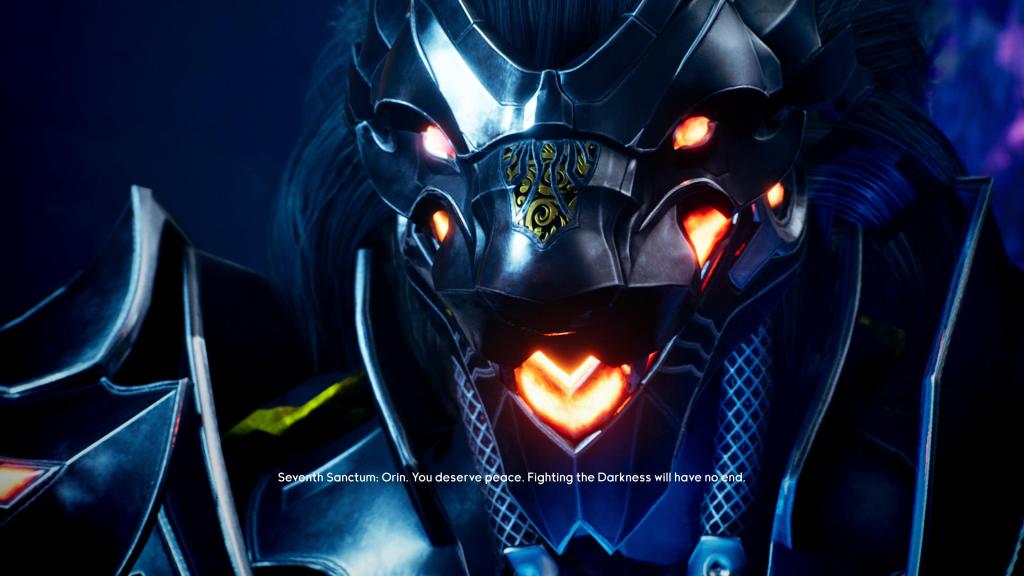
An ominous end with foreshadowing…sequel perhaps?
-Game Info-
Godfall
Genre: ARPG
Developer: Counterplay Games
Publisher: Gearbox Publishing
Release Date: 11/12/2020
Platforms: PS4|PS5, PC

-GamerDad Info-
Completed On: 8/23/2021
Played On: PS5
Time Played: 50 Hours
Rating: 6.75/10 - Super Robot Wars 30 | Game Review
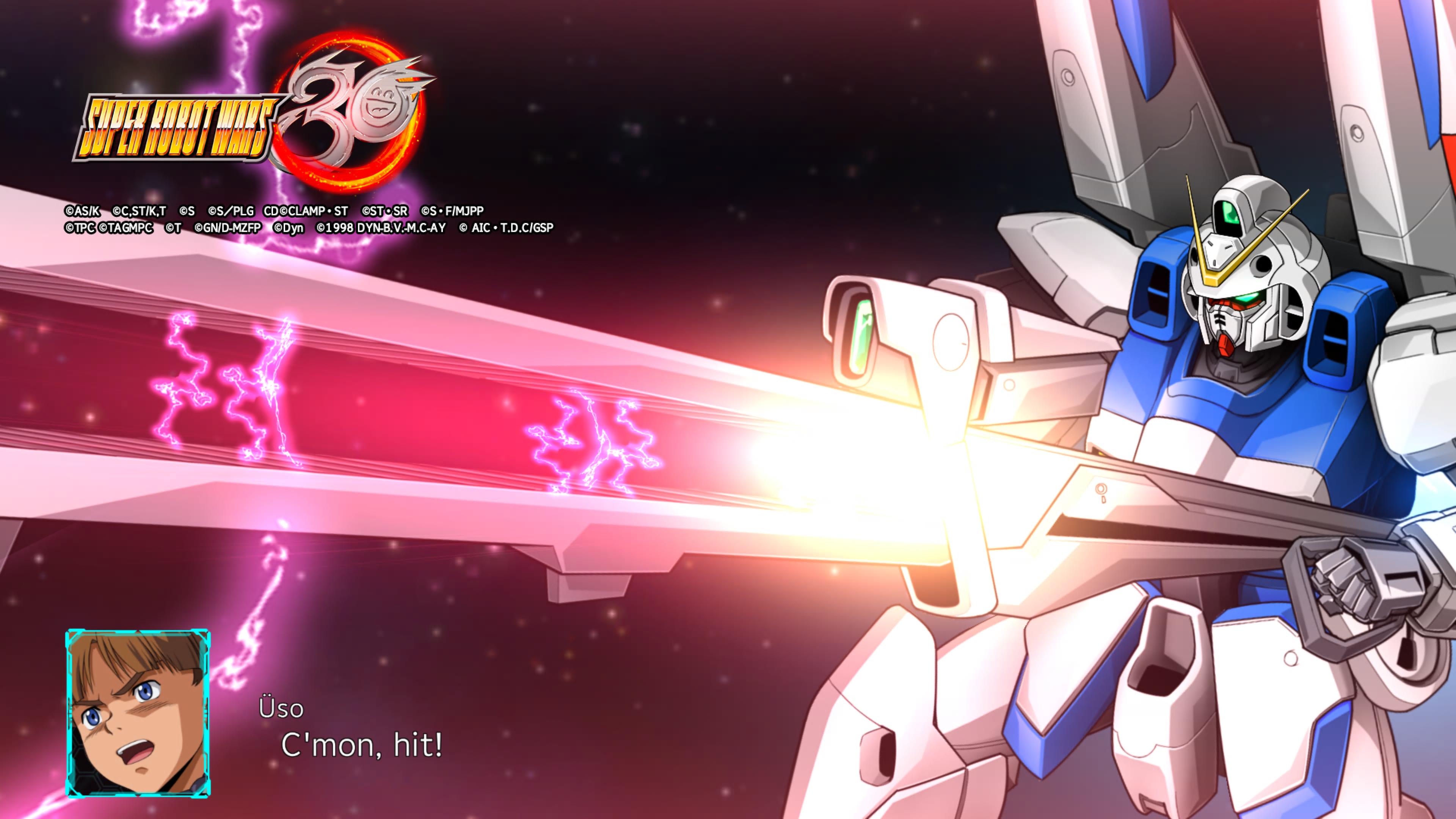
QoL improvements make this SRW entry an excellent starting point for newcomers looking to dive into the ultimate mecha mashup.
30 years of mecha goodness has culminated into the most recent iteration of Super Robot Wars, appropriately titled Super Robot Wars 30. For those who are unaware, Super Robot Wars is a franchise about mechs duking it out against various evil forces to save the world, universe, etc. While the O.G, or Original Generation games have unique creations, a staple component of the Super Robot Wars appeal is the inclusion of mecha from a vast number of franchises spanning manga, anime and video games.
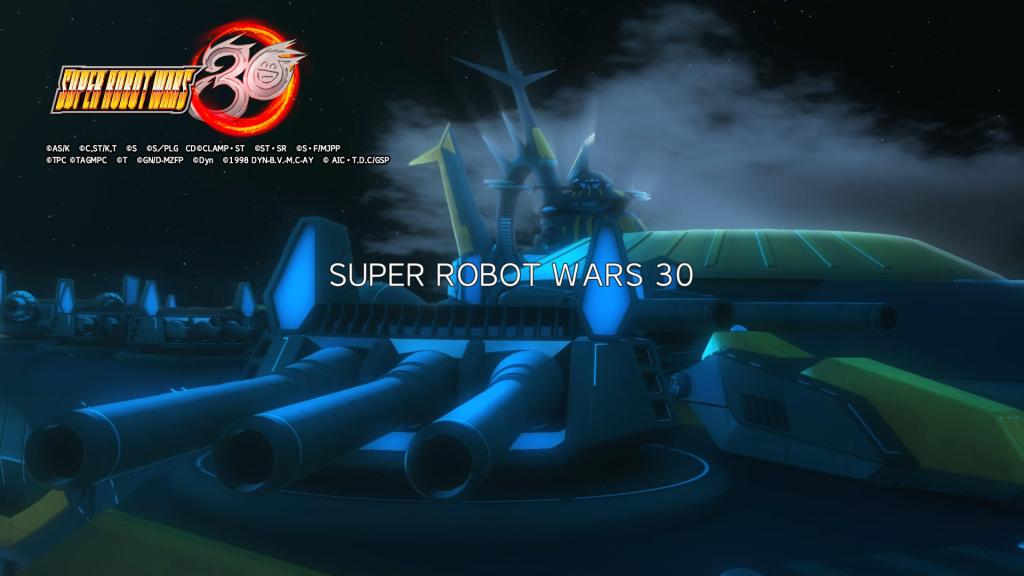
Opening sequence showing the humongous size of the flagship, Dreisstrager Due to this, licensing has been problematic as far as evolving the series outside of the Asia/Japan regions, but Super Robot Wars 30 has finally broken the barrier and had a release internationally (on Steam), hopefully paving the way for future releases to follow suit. Now, the Southeast Asian releases have had English subtitles in the recent modern releases like O.G Moondwellers, V, X, and T, making them still enjoyable and very playable. In fact, Super Robot Wars X was my first entry in the series and I instantly fell in love with the over-the-top tropes that you’d expect from all of the franchises included, as well as being introduced to so many new and unfamiliar IP’s. In the past I’ve been essentially forced to import them from reputable sites like PlayAsia, but importing certainly adds to the cost, so hopefully this release broadens interest and success for these games.
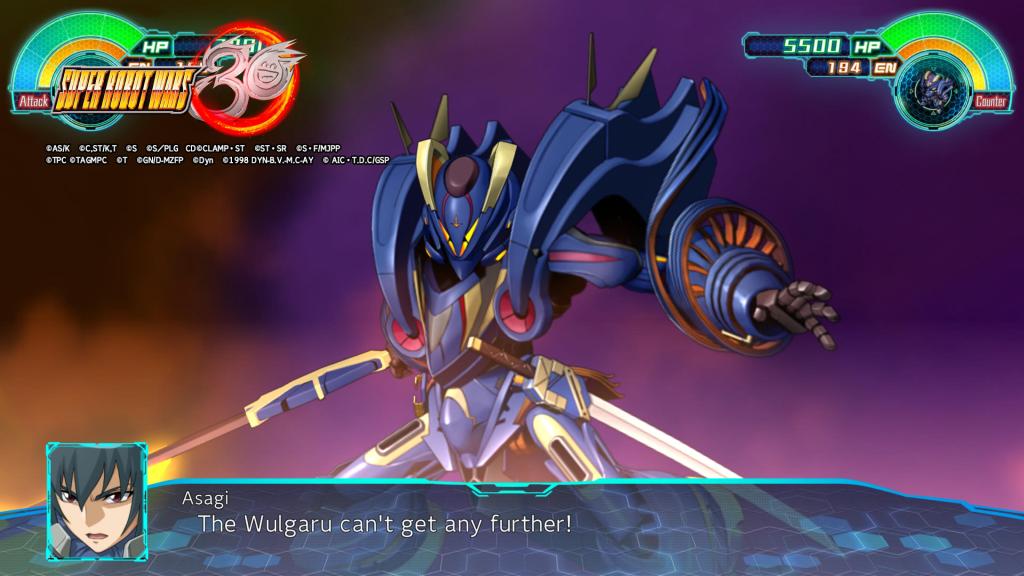
The series debut of Majestic Prince You begin with your choice of protagonist, which I gotta say, makes little difference in the grand scheme of things. Not only that, they are very cliche designs, nothing about them really stands out to me as unique or intruiging. I could say the same thing about the previous titles I’ve played, but it just felt like they missed a great opportunity to have a more customizable protagonist. You then can change your name, birthday and blood type. Odd selection of things on its surface, I know, but fans of the series know very well that birthday and blood type can result in a subtle difference for someone who isn’t paying attention. Those two options are linked to your main characters’ pool of Spirit Commands that they will acquire as they level up…and yes some are WAY more valuable than others. This change can be subtle, or it can make the difference of having a skill like Drive available 10-15 levels sooner, or even having a skill like Daunt that you wouldn’t normally have access to for that character.
Your bread and butter are your mechs and pilots, with each having their own upgrades. The true goal here is to upgrade both, as that will boost your overall CP, or Combat Points. Higher CP will yield stronger enemies, which give you more EXP, Pilot Points, and Mxp. Pilots can be equipped with various passive abilities and can also be given permanent stat boosts. Understanding the way the numerous mechanics work will help you understand the boons each ability provides, as things that sound basic enough like Morale can easily be the reason your unit gets one-shotted. Another crucial element to upgrade is your flagship itself, the Dreisstrager. Yes, you can upgrade the ship itself and the captain/co-pilots, but the real benefit is the AOS upgrades that the ship provides. These bonuses are HUGE, and many of them apply to all mechs. A fully upgraded AOS can have you starting off fights with 3+ ExC Points, boosting move and range of your fighters, as well as permanent attack bonuses. Even increases to your rewards are available, which come in handy with the disturbing amount of money that will be spent upgrade those ships and pilots.

Attack sequences for some units just never get old, especially if it’s unique dialogue for certain enemy encounters I’ve noticed that the game has some quality of life improvements that set it apart from its most recent predecessors, and I’m in full agreement that they make the game much more accessible for newcomers, as well as those who like to min/max and grind a bit before they tackle story objectives. There are various different missions that can be tackled, and as long as you aren’t being forced to an emergency scenario, you can feel free to do them in however order you please. Missions that are have a star on them will progress the story, while yellow are recommended usually due to them leading into further story missions or they are within your CP range. DLC missions and special scenarios are awesome because they may provide you with new units, massive improvements to your current units, or just a bunch of resources for your disposal. Because of the way that the missions are offered, you can really play the way you want. If you are the type to clear the entire board before you progress the story, you are perfectly able to. For those who want just the story, that is perfectly viable too.
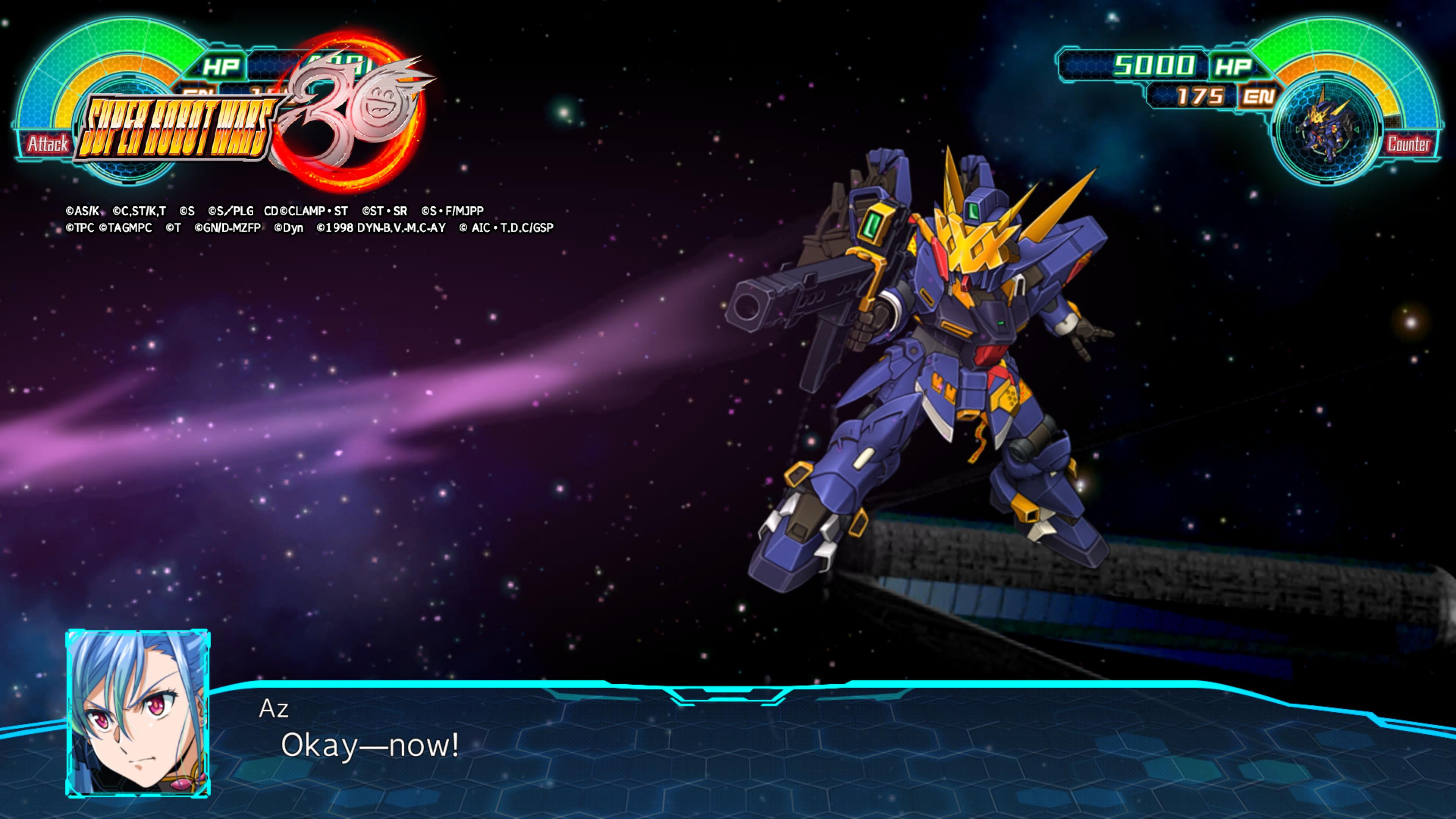
The Huckebein 30 sports a XXX on the mech for…you guessed it! The 30th Anniversary! Now I haven’t spoken much upon the story because I personally feel it’s the weakest part of the game. As your wolfpack increases with progression, you uncover multiple plots of enemies, whether they be foreign, domestic, and alien, that it just feels like EVERYBODY is out to destroy the world. It just feels all so convenient that multiple groups of bad guys are going ahead with their evil schemes and oh wait, of course they are cooperating with this other group of bad guys. Didn’t see that one coming at all! And as you pulverize these groups you find out that, of course, there’s another group that’s behind them but just capitalizing off the chaos. Very predictable. Aside from the predictable story lines, my biggest gripe as a player of the recent games was the lineup they had for this one. There were some awesome units included, but I feel like once I got my squad of 10 favorites, I solely used them and was still able to steamroll the entire game. It might really just be personal bias, but I was a bit upset favorites like the Villkiss, Great Might Gaine, Dunbine/Sirbine to name a few, weren’t included. That being said, this was a first for inclusion of a few series’ so I suppose there had to be a tradeoff somewhere. Also, I feel the protagonist mech, the Huckebein 30, just felt so unimpressive compared to the Xelguard (SRW X), Tyranado (SRW T), and VangRay (SRW V). To top it off, there was screen capture blocks after about the 4th mission or so, which was upsetting because there are just so many awesome moves and moments that I couldn’t capture, but this is most likely due to licensing restrictions.
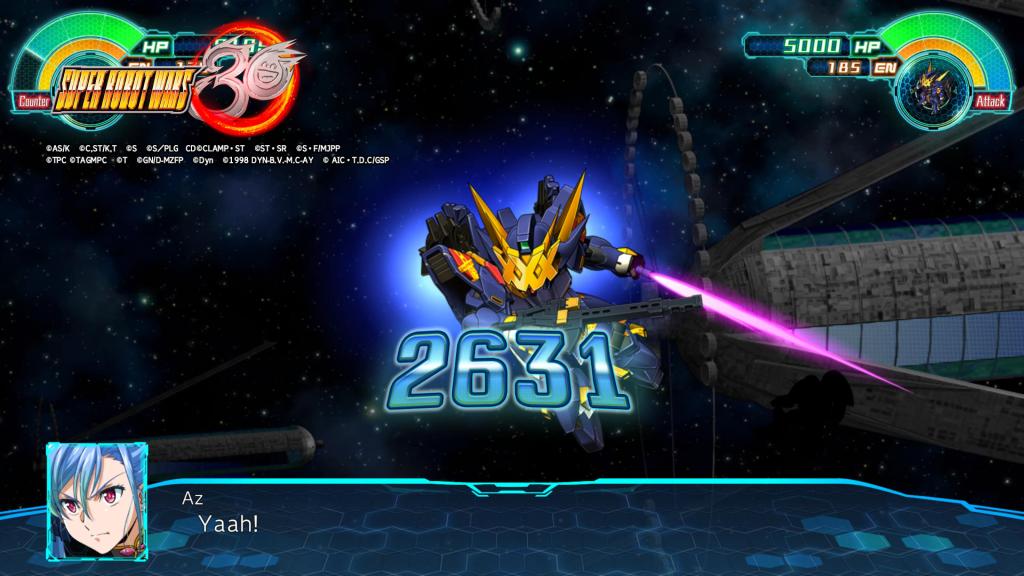
Don’t worry, despite some basic looking attacks, the main mech can still hold its own. But as you progress and gain some cool units with awesome attacks, it really begins to feel underdeveloped. Overall, Super Robot Wars 30 is an excellent choice for fans of mecha and SRPGs. I came into the series only knowing Gundam, and now I’m so excited to learn about the multitude of others that I’ve been presented with (and hoping they have been localized). So if you are thinking that you need to know every series included to enjoy the game, don’t let that be a deterrent, as this game is more than enjoyable just learning them as you go. I stumbled upon it only knowing some Gundam that I watched on TV as a kid, and not even really being a big SRPG player, and ended up loving loving series. It has a unique charm that goes beyond its dated graphics and presentation, so here’s to hoping Super Robot Wars 30 is the success they need to truly elevate the series to the next level.
-Game Info-
Super Robot Wars 30
Genre: SRPG
Developer: Banpresto, B.B Studio
Publisher: Bandai Namco
Release Date: 10/27/2021
Platforms: PS4, NSW, PC

-GamerDad Info-
Completed On: 11/13/2021
Played On: PS5
Time Played: 110 Hours
Rating: 7/10 - Voice of Cards: The Isle Dragon Roars | Initial Impressions
O Holy Square Enix, thou hath once again given us a world to explore and uncover its secrets. However, this time around we have an adventure told entirely in card format, adding a unique flavor to the atmosphere and spirit of the game.
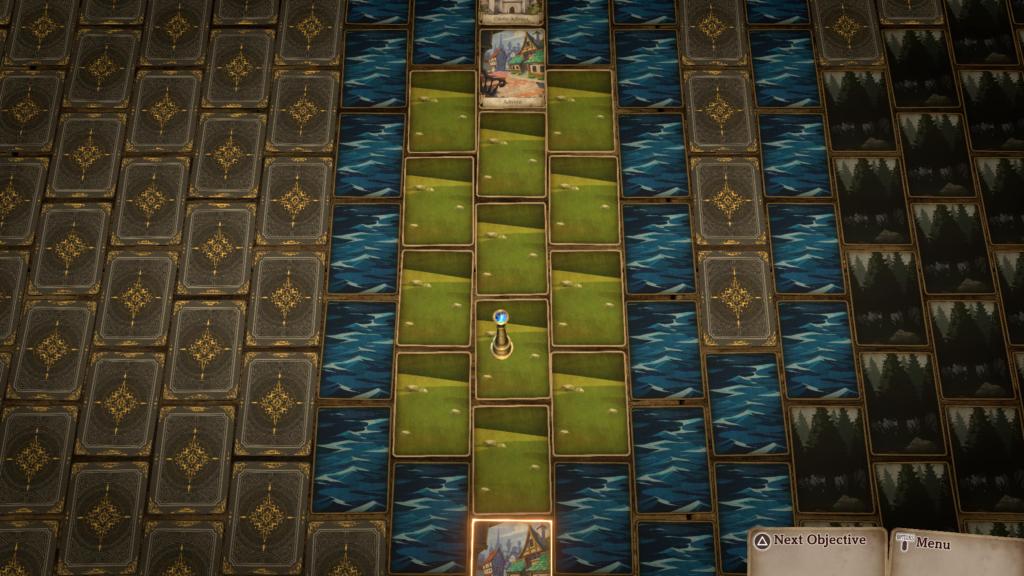
Gotta flip ’em all Voice of Cards: The Isle Dragon Roars takes the card medium to another level by fusing it with a witty narrative, beautifully composed melodies and a detailed world that you would expect from the makers of NieR. This is a light RPG that is very accessible for those who can’t sink 80+ hours into an RPG.
Don’t expect some sort of trading card game though, this is an RPG entirely constructed around cards: the characters, items, environment, etc. Character and monster cards have additional flavor texts and stories to unlock as you progress, providing those quirky little tidbits of lore that really give the game its personality. The protagonist is a half-assed adventurer who is only seeking coin for his own selfish needs, and answers the call to slay the Dragon plaguing the land. You and your faithful monster pal, Mar, set off on a quest, seemingly trailing behind the fabled Ivory Order trio who are really just your run-of-the-mill, arrogant, pompous heroes.
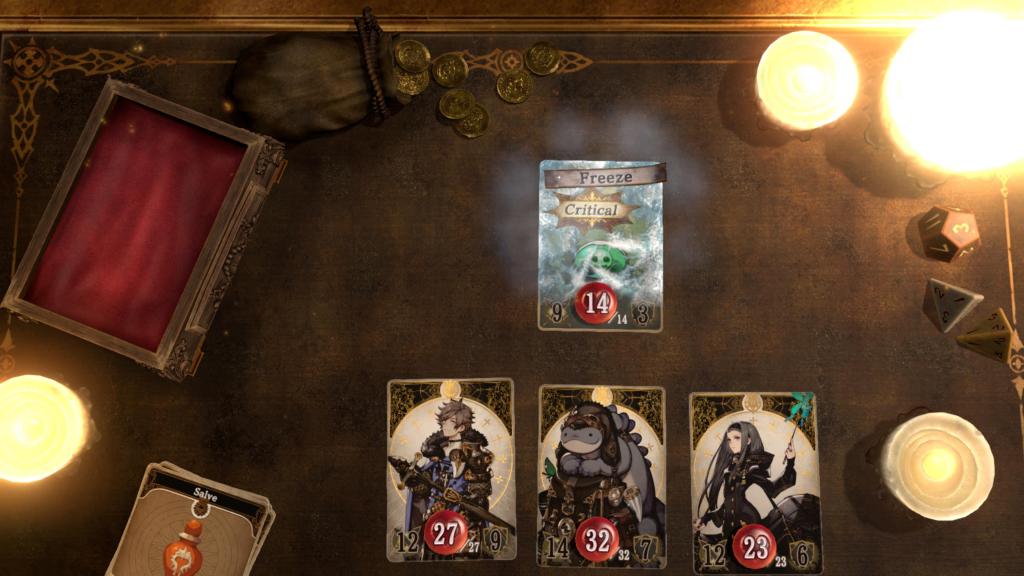
Battles are a tabletop affair featuring a turn-based system and straightforward attack and defense check system. If you have 20 attack and your opponent has 10 defense, your final damage will be 10. I’ve noticed very small fluctuationsoccasionally, but for the most part it’s pretty damn consistent. Simple enough, right? This changes with resistances and weaknesses, as well as critical. Some attacks can add flat damage, or random damage based off of a dice roll. Status ailments also are triggered off of dice rolls, which I enjoy because despite it still being somewhat up to chance, the act of “rolling the dice” gives the illusion of the player having control. Some battles have a Happenstance, cards that can alter the flow of battle by offering bonuses that can benefit your team, or everyone including the enemies.
Another nice little touch are the random events that can take place on the map or in dungeons. Some are expected, like “roll X or higher to avoid damage” from a trap. Others can provide rewards based off of the response, such as choosing to listen to the singing or looking for the singer in the Bewildering Forest.
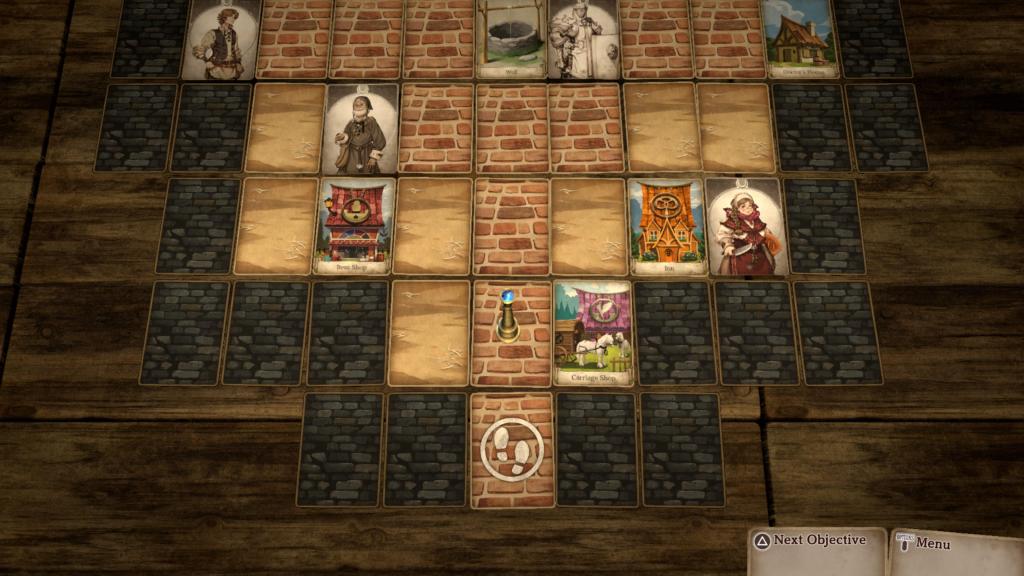
Time to go and talk to everyone multiple times and explore every card because, you know, it’s an RPG? Voice of Cards isn’t a super complex RPG, and I’ve made some decent progress in chapters to know that this game feels much smaller in scope and content than your typical RPG excursion, but that’s perfectly OK. Most card games don’t take too long to complete so I think the way that sort of sentiment is translated into this RPG experience makes it more approachable. Also, card games can feel very daunting as well with numerous mechanics, rules, and of course a massive amount of collecting. Voice of Cards topples that notion with a much tighter, compressed game that feels more relaxing to sit back and enjoy than the usual stresses of RPG completions. As someone who tends to play multiple RPGs at once, being able to just bask in some excellent music and a wonderfully detailed world is a delight. Looking forward to how the rest of the story plays out!
Stay tuned for the full GamerDad Review!
- Hades | Game Review
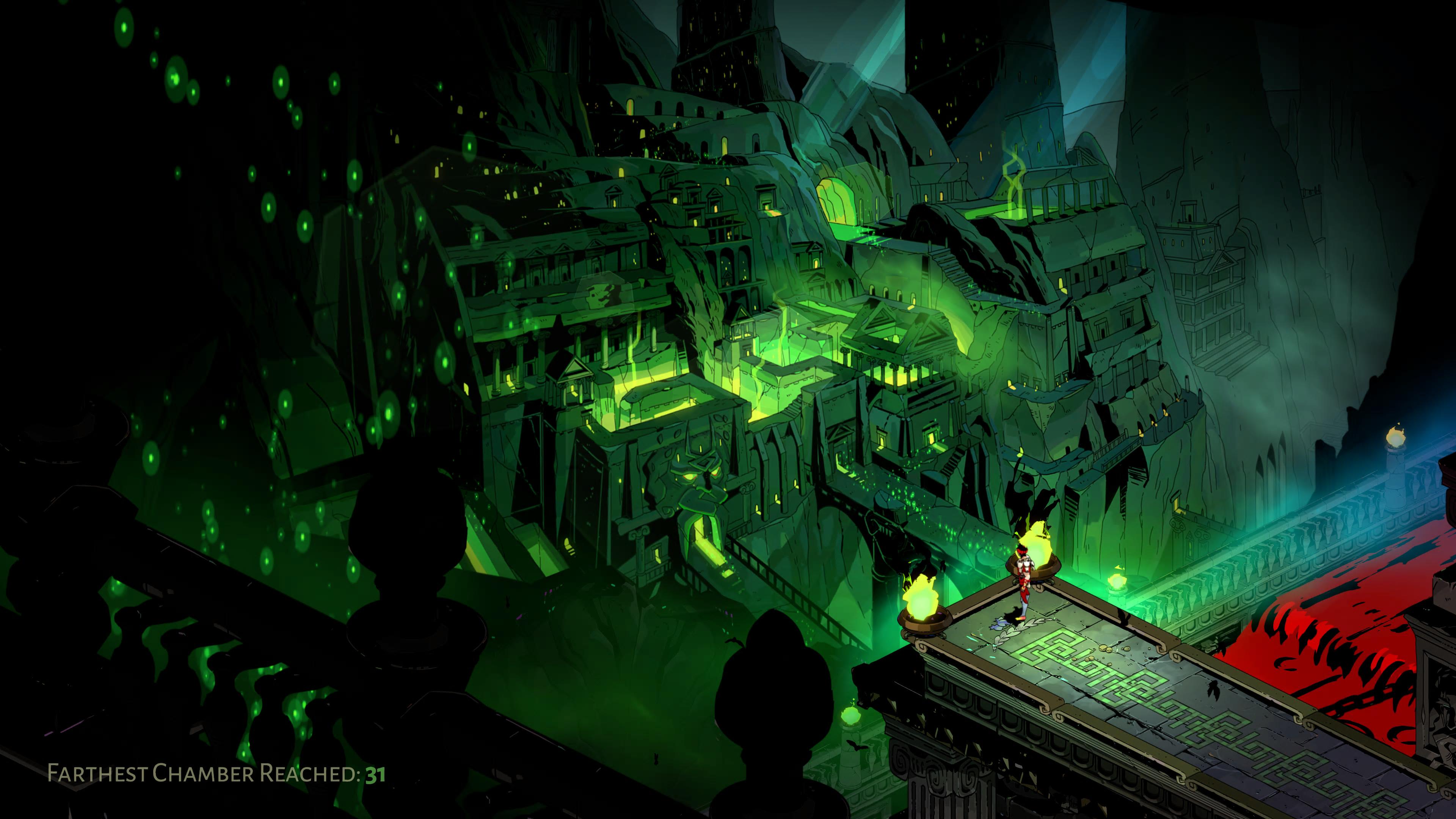
Hades is so well put together, it’s hard to find flaws in its design. It checks all the boxes: amazing music, a masterful and witty narrative, depth and meaningful complexity, and most of all, it was just damn good fun. Hell never looked so stylish.
Completing Returnal spawned a fire in me that pushed me to start challenging myself with games that were tougher, or at least out of my usual comfort zone. I eventually toppled Demon’s Souls Remake, and that was a sigh of relief upon completion. I figured since Returnal was a roguelike, why not check out the genre a bit more? The timing could have not been more perfect because one of the most incredible games of the genre happened to grace consoles: Hades.
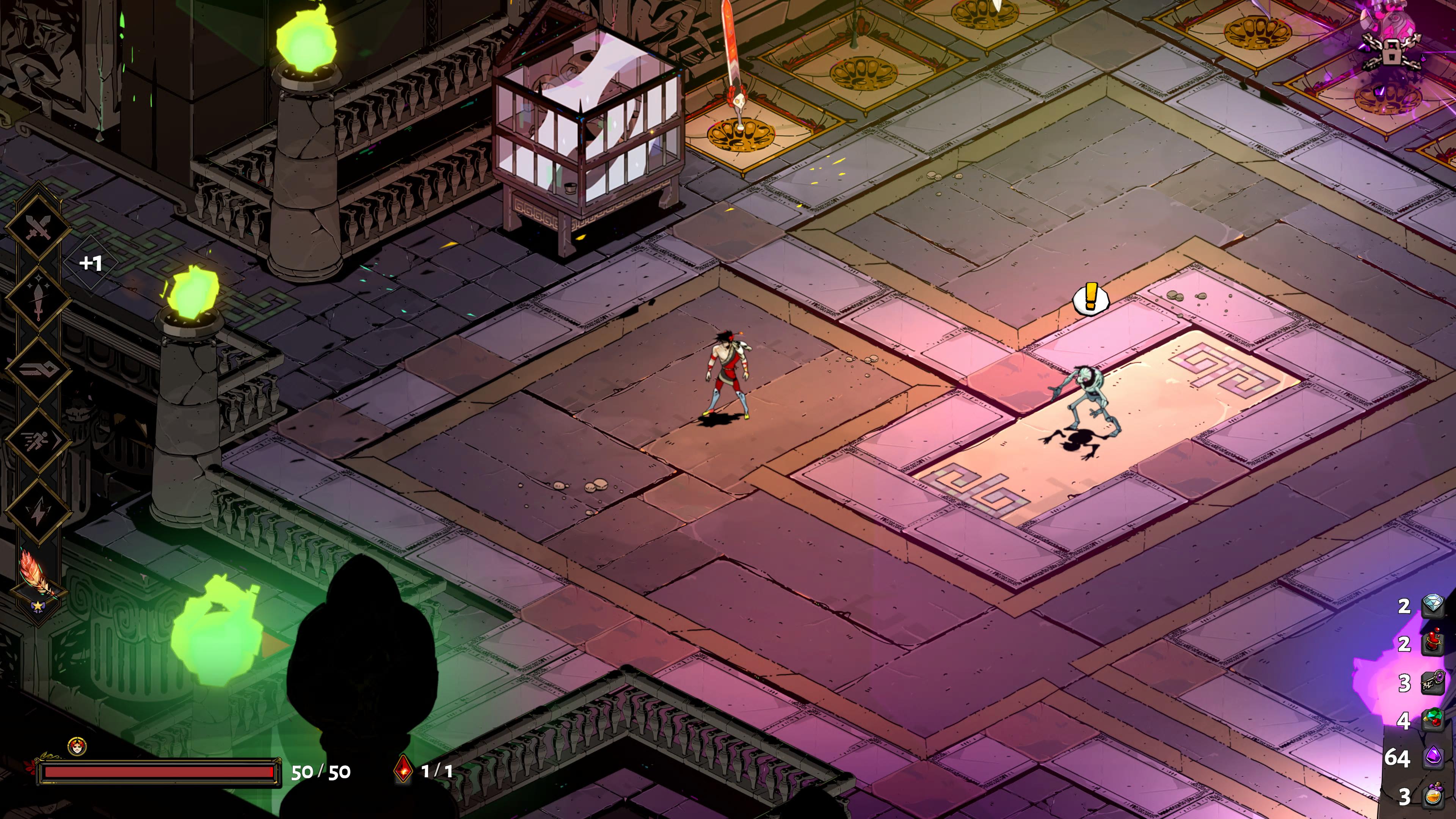
As you progress (and die) eventually you will be able to unlock new weapons, and giving various characters Nectar will get you a keepsake; equippable items with passives that level up with each successful floor. The concept of Hades is quite simple. You play as Zagreus, and you pretty much have a crap relationship with your father Hades and you want out. Problem is, the layers of Hell aren’t too keen on letting you disobey Daddy, so all of the inhabitants of Hell are against you in hopes of gaining favor with him (they never do). Zagreus makes it his goal to get to the surface and see his family, the Olympians, and they aid him in his quest by offering special power-ups called Boons. They each have their reasons for doing so, whether it’s just curiosity, bloodshed, or just sticking it to Hades, they offer you abilities as well as quips and some backstory into the happenings on Olympus and the state of affairs for the family in general. Many of us have read the books, poetry and stories of the Greek gods and their feats and defining characteristics, as well as the fact that they seem to possess immensely human qualities. I’m not going to get into the deep topic of mythology because, although it is one of my favorite subjects it would end up manifesting into something much bigger. For sake of simplicity, they are just like us except with vast powers and immortality. As you can imagine, this is one super dysfunctional family.
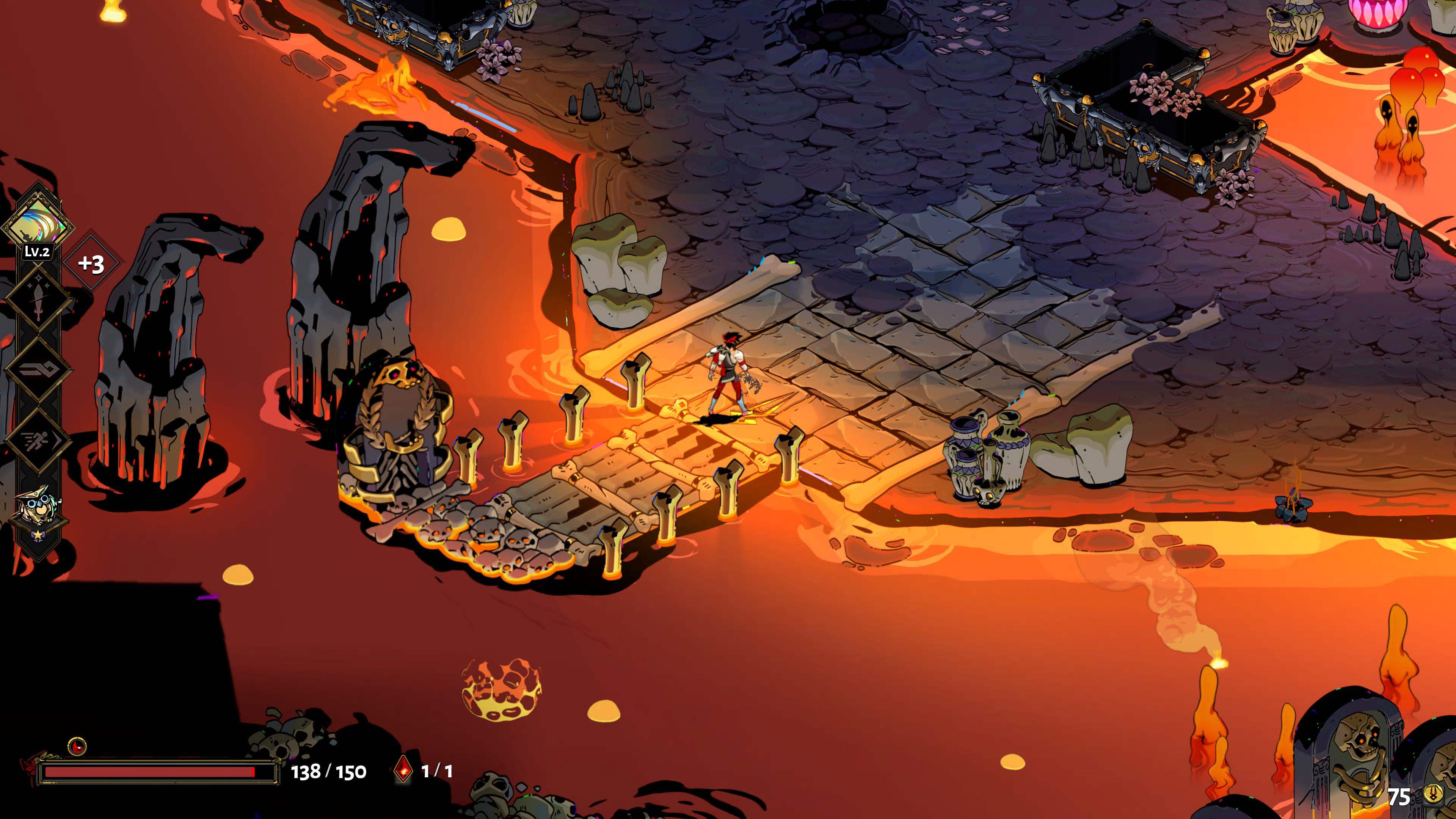
On my way to see you again, Lernie! Hades took what could have been a simple death loop, and made it so it truly felt like each run was different. Over the 100+ runs I did in my 100 hours of playing, I don’t think I encountered an NPC giving me the same dialogue twice. Rogue Legacy sure had the challenge, but it absolutely lacked depth as far as a story and meaningful growth of characters. In Hades, you grew close to the characters, felt kinship with your cousins, definitely flirted with Aphrodite, and looked forward to those brief surface moments, all to do it over again. But even in doing so, you progressed. Questlines progressed through dialogue and certain events taking place, so through death you are actually progressing by having another opportunity to continue the dialogue. You invest in the Mirror of Darkness courtesy of Nyx to gain passives that will give you an edge for your next run, hopefully making it a few more floors farther.. While it is worth it to stick with a solid combination of boons while learning the ropes, you will eventually get to the point where you can clear every level of Hell regardless of what boons you have and regardless of your weapon choice.
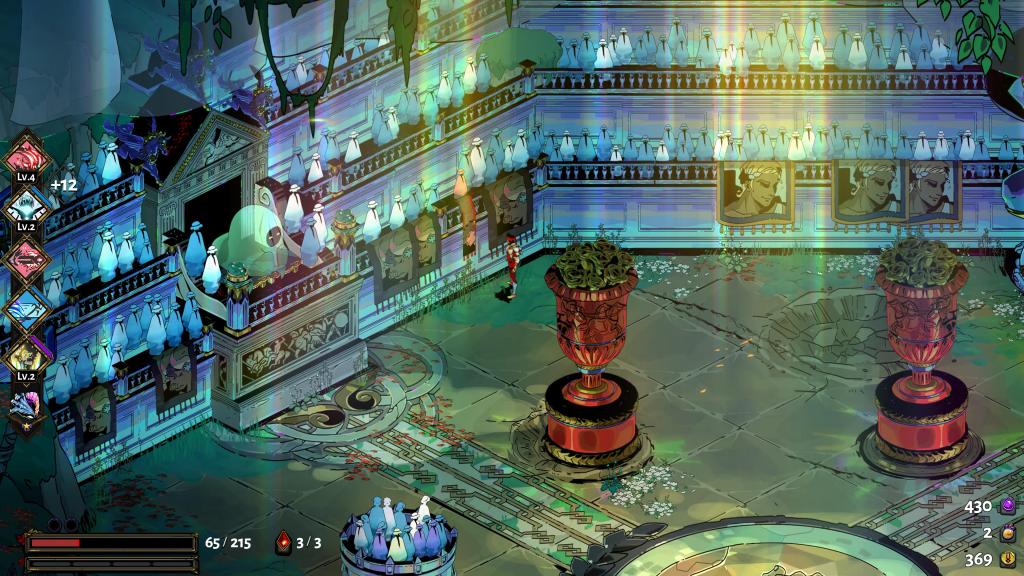
Thank you, my good shade! You have several means of attack in your arsenal as you adventure to the land of the living. You you have a basic attack and special attack, which are influenced by the weapon you are wielding. You also have a cast skill, which I guess could be considered a ranged/magical attack? To top it off you can dodge…and even that can take the form of an attack with the proper boon setup. Survival is key on the mastery of these techniques, and it really just becomes a new experience once you are able to coordinate your skills in sync with the boons you have. I cannot stress to you enough that just having awesome boons will not make you successful. You will learn how to you use them properly, and what compliments your playstyle. Even the most seemingly simple boon can give you awesome might when used properly or in tandem with another.

After getting these rewards once, you’ll need to raise the stakes with Heat levels to get them again. Upgrading your weapons and your Mirror are crucial to progression in Hades. The Mirror features amazing passives that can be purchased with Darkness, a currency that can be found as rewards in some chambers, or exchanged. I find that the best way to farm Darkness is to do runs using a weapon you’ve already cleared with. Instead of items like Diamonds, you’ll get Darkness instead, and a decent amount at that. Far more than you normally would from clearing a room. Among useful upgrades are abilities that can increase chances for Legendary Boons, additional lives, and extra casting ammo. Once you have a few runs under your belt you are able to start challenging yourself even further. Why would you want to make this game harder, you ask? Well, after you clear bosses with X weapon, you can no longer get those high value rewards anymore. You are introduced to the Heat system, which allows you to adjust aspects of your run to increase difficulty, and by doing so you reset the ability to unlock items such as Titan Blood, Ambrosia, and Diamonds. Hidden Aspects are unlocked much later and drastically change the way the weapons work, almost to the point where you may need to relearn the weapon. However, they are immensely powerful when properly used. The Exagryph was not really my style but let me tell you…the Hidden Aspect makes that bad boy a shredder. Paired with an attack boon that has continuous or stacking damage, like Zeus or Ares, and it becomes a laser beam of calamity.
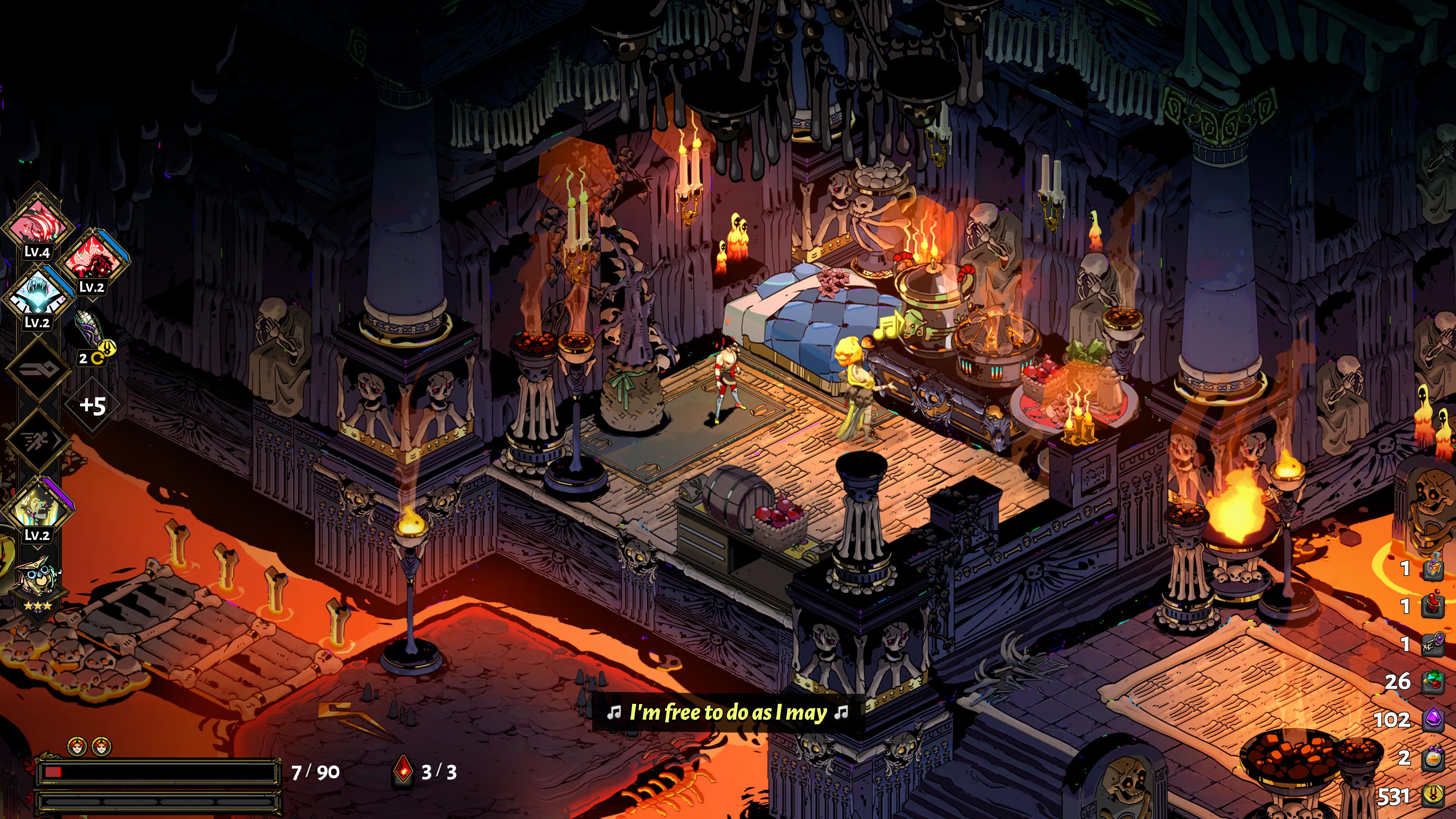
O sweet angelic voice. Only thing that makes it better are those upgrade offerings she has in store for you. As you learn secrets about the family, and about yourself, you begin to uncover why things are the way they are. Nevertheless, the ever determined Zagreus continues to defy odds through the graces of the Fates themselves, and eventually makes it to the surface. In between all the constant death are moments of bonding, rivalries, insults, jokes, sorrow, despair, regret, hatred, and everything else imaginable. The House of the Dead is filled with various characters who have their own struggles, as well as the few important individuals you meet through your travels. It’s these moments of dialogue and connection that set Hades apart from something Rogue Legacy or Returnal. It feels personal, because I think everyone one of us can relate to some sort of family issue or relationship that is being strained or tested. And despite them being Gods, the dead, or everything in between, Hades somehow found a way to make it all seem so human and alive. Quests like aiding Orpheus to seek his muse just made the halls of Hell seem to grow joyful somehow when you are finally completed. Let’s not forget to mention that enthralling melody from Eurydice whenever you stumble upon her chambers. The song was so beautiful I would find myself just staying in the room a bit longer as sort of a respite from the chaos above and below. It showed that even in the pits of Hell, there was still life, love and beauty to be found for those daring enough to seek it.
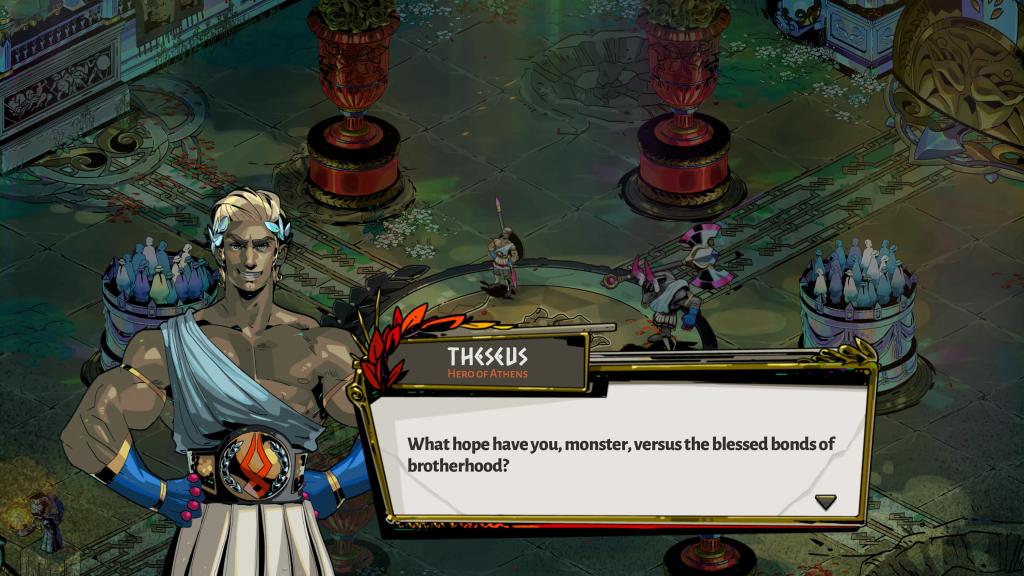
Creating characters that people like must be tough, but creating a character who is just so genuinely disliked, that’s talent. Hades is so well put together, it’s hard to find flaws in its design. It checks all the boxes: amazing music, a masterful and witty narrative, depth and meaningful complexity, and most of all, it was just damn good fun. Let’s not forget how gorgeous Supergiant Games managed to make Hell and all of its denizens, it was like journeying through fine art. Perhaps the only downside I can think of is that the genre itself may not be for everyone, and even additional features like God Mode don’t guarantee success. However, for those hungering for an excellent game that will keep you pushing for the quickest clears, and challenging yourself in a plethora of ways to perfect it, Hades is a no-brainer. Make no mistake, Hades is a must-play for this generation and Supergiant Games continues to raise their own bar higher.
-Game Info-
Hades
Genre: Roguelike/Dungeon Crawler
Developer: Supergiant Games
Publisher: Supergiant Games
Release Date: 12/6/2018 | 8/13/2021
Platforms: PS4/PS5, XB1/XBS S/X, NSW, PC

-GamerDad Info-
Completed On: 9/8/2021
Played On: PS5
Time Played: 102 Hours
Rating: 9/10 - Astria Ascending | Initial Impressions
I need you to seek out the nearest person you know who told you 2D games are out of style, and smite them into the deepest pits and hell. This is just an utterly gorgeous game. Astria Ascending is easily one of the most visually pleasing games I’ve played this year.
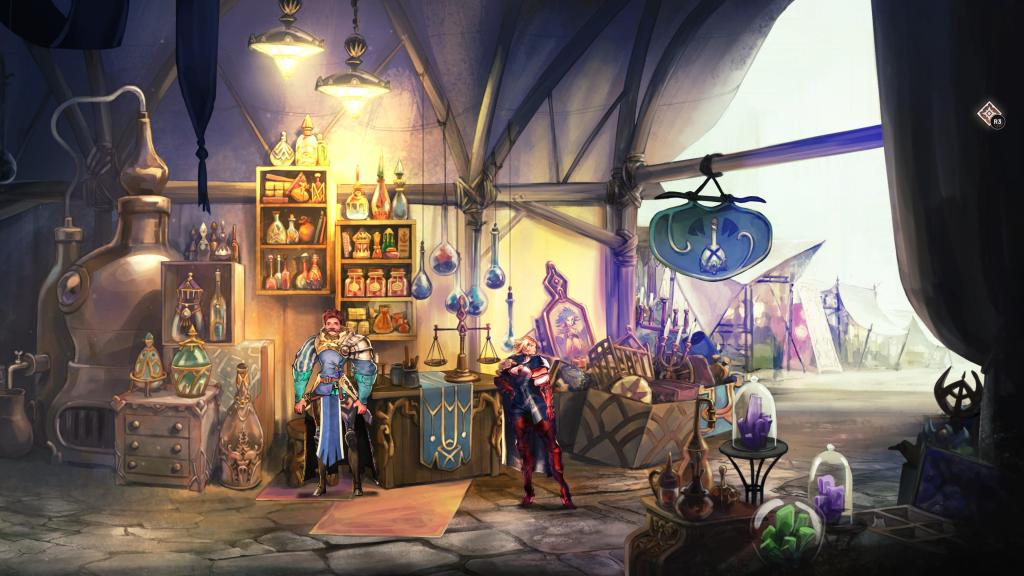
The detail is just immaculate. So much love and attention in each frame Astria Ascending is a 2D turn-based JRPG that puts you in the helm of the Fated Eight, a group of chosen Demi God’s who are tasked with defending the world of Orcanon from ancient beasts that threaten the very fabric of the world. Filled with beautiful detail, vibrant color palettes and fantasy designs, Astria Ascending has the heart and soul of classic JRPGs and an art style that is very reminiscent of Odinsphear and Dragon’s Crown. And similar to those games as well is its side-scrolling platforming and locale traversal.
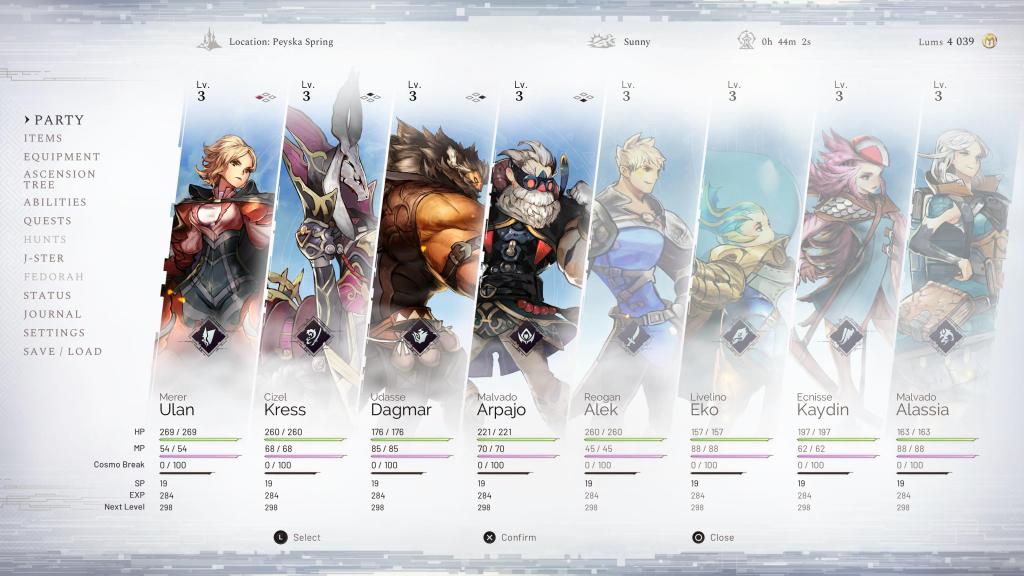
My Fated Eight were not looking so hot early on. Thankfully the progress and pacing never has you feeling overwhelmed or woefully unprepared Combat is tried and true turn-based, but with a unique system of exploiting weaknesses that can turn the tide in your favor. The enemy can take advantage of this as well, so strategic strikes will pay off and give you an advantage. I have dabbled in a few side quests and put only a few hours into the game, but I can tell that this one is going to be a sleeper hit for me, for sure. I’m not too fond of platformers but controls were solid and responsive, and the locations just look so damn good that I WANT to explore them. Each character’s personality and their interactions also is a perfect touch, so I’m excited to see where my travels in Orcanon take me as well as learning more about the Fated Eight themselves.
Stay tuned for the full GamerDad Review!
- Super Robot Wars 30 | Initial Impressions
It’s impressive (yet saddens me) how an entire franchise can span 30 years and remain largely unknown on the Western front, but SRW 30 seeks to alleviate this with the first ever English release on Steam. Not the full English release on current gen consoles that we would like, but the Asian version has English language selection so it’s very playable. Still, this marks a significant step forward in the franchise. I hope that a release will one day occur that I don’t need to order from another region to enjoy this amalgation of mechanical harmony.
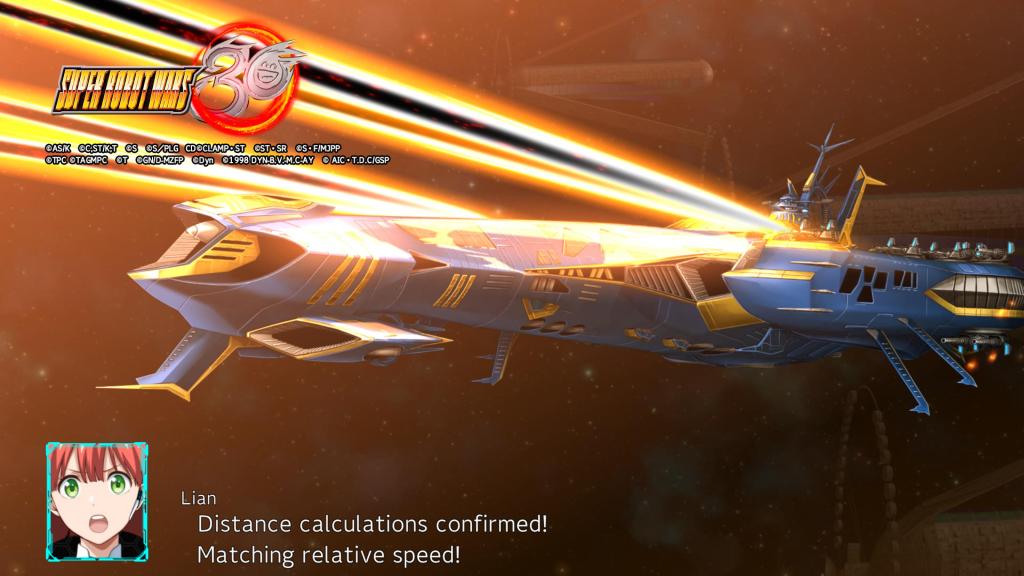
SRW 30 is a strategy RPG in which you mobilize your mechs on a grid, balancing different attacks to overwhelm your opponents before they do so to you. Each unit varies in strength and ability, and the same for Pilots as well. Fans of mecha anime series will gush over the sheer magnitude of inclusions here, and even though I don’t understand the language without the subtitles, I understand cool robots bashing each other, so it’s still very awesome to play. Attacks play out like those flashy battles you see in animes, and many attacks retain their signature charm from their respective sources. You get various currencies to upgrade mechs, pilots, and a new passive bonus system called AOS. It can be cumbersome at first, but very rewarding after you learn how to work everything in sync. Also a departure from the recent iterations is a world map that allows flexibility and much needed freedom with missions.
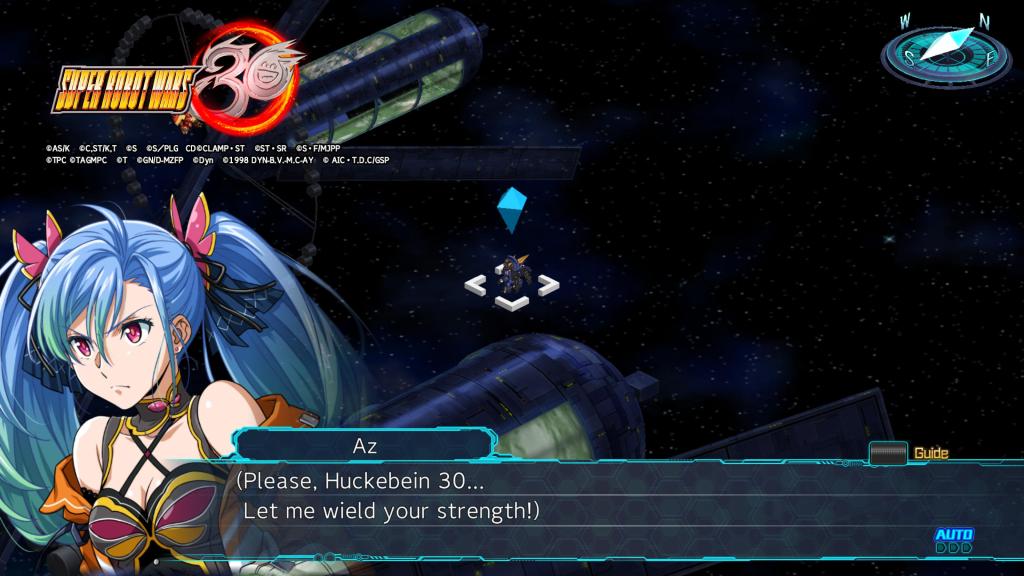
The slow paced gameplay may not be to everyone’s liking, but for those that like to fine tune units, customize their squads and loadouts as well has achieve synchronization between their units, this game can offer huge replayability as they are designed to be be played more than once. Graphically speaking, there isn’t much of an improvement from its predecessor, but the graphics aren’t the highlight for a niche product like this. It’s gameplay and the mechs, and there’s plenty of both. My enjoyment of Gundam brought me to the series with SRW X, and I’ve stuck around for the releases since. This franchise is a must for lovers of anime mecha and SRPGs, and so far this seems to be the most user-friendly iteration with plenty of explanations and tutorials.
Stay tuned for the full GamerDad Review!
- Final Fantasy Type-0 HD | Game Review
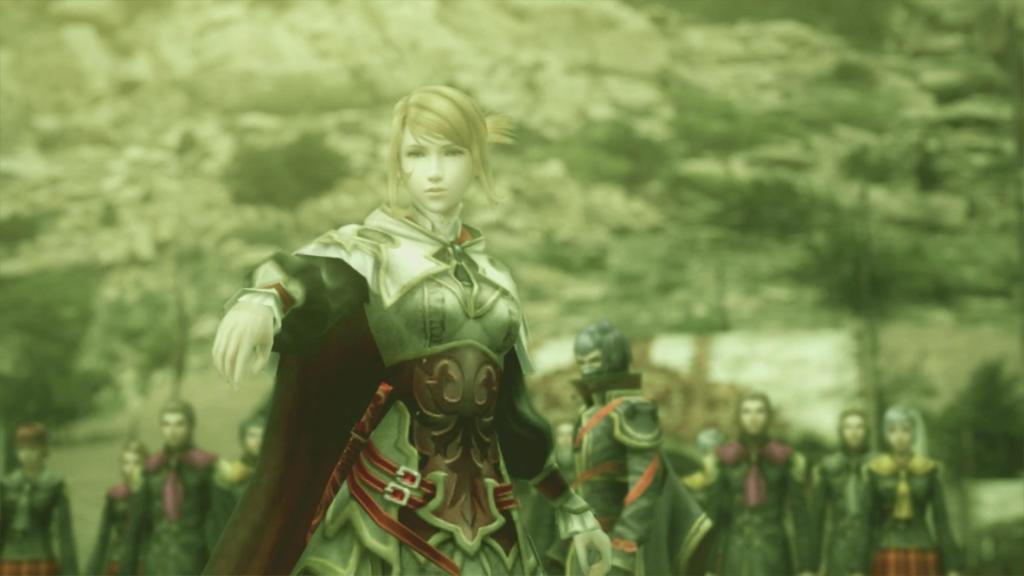
Type-0 HD is a bit of a double-edged sword in that it has grandiose worldbuilding and lore that is still marred by the limitations of its original PSP release. If you can look past that, you’ll find a solid entry within the Final Fantasy universe.
Many non-mainline Final Fantasy endeavors have failed to stick their landing and really be on the same playing field as the mainline series. Having played most entries, I found that X-2 was rushed and ultimately was unnecessary as X was masterfully done. XIII-2, while a bit outlandish and all over the place, at least has it’s biggest strength in introducing Caius, who is a highly underrated antagonist. I’m mixed because without that title we wouldn’t have LR:FFXIII, which I personally enjoyed although it scaled things back with no party members and a time management system. It felt more niche but I love Lightning so I’ll lap up anything I can get. Dirge Of Cerberus was decent, but the shooting mechanics were not as crisp as they needed to be, and let’s not forget that any additional VII material is wrapped up within the PSP, making it inaccessible for some. While different platforms are great, it certainly doesn’t aid in continuity. All of this brings me to Type-0, or more accurately, the HD version.
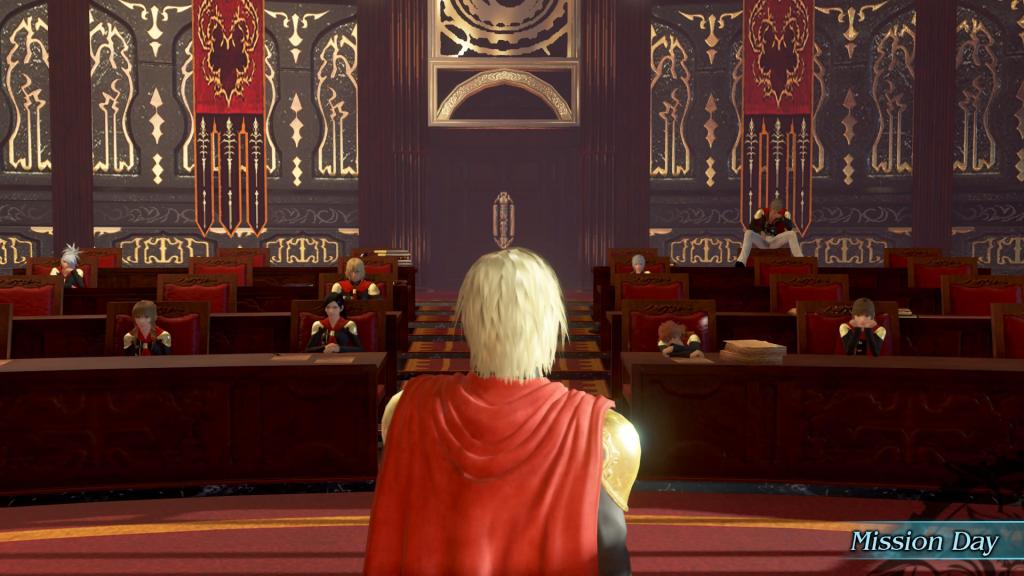
Class Zero being a bunch of slackers before the work call The story of Final Fantasy Type-0 HD spans various regions in the world of Orience. You play as the students of Class Zero, a group of 14 individuals, each with their own skills and choice of weapon. Their strength and exploits are highly regarded among Rubrum, the Dominion you are sworn to. Each Dominion has a crystal, until one day the Militesi Empire begins to launch attacks and claiming crystals. Your team of 14 is dispatched to defend Rubrum, and this is the start of the journey to protect your nation, as well as uncover the truth behind the mysterious origin of Class Zero, and the powers that are plotting to plunge the world into chaos. One thing that immediately stands out is that this game bears a much more darker tone than most games in the series, and is heavily based on military manuevers and political tensions amongst the various regions.
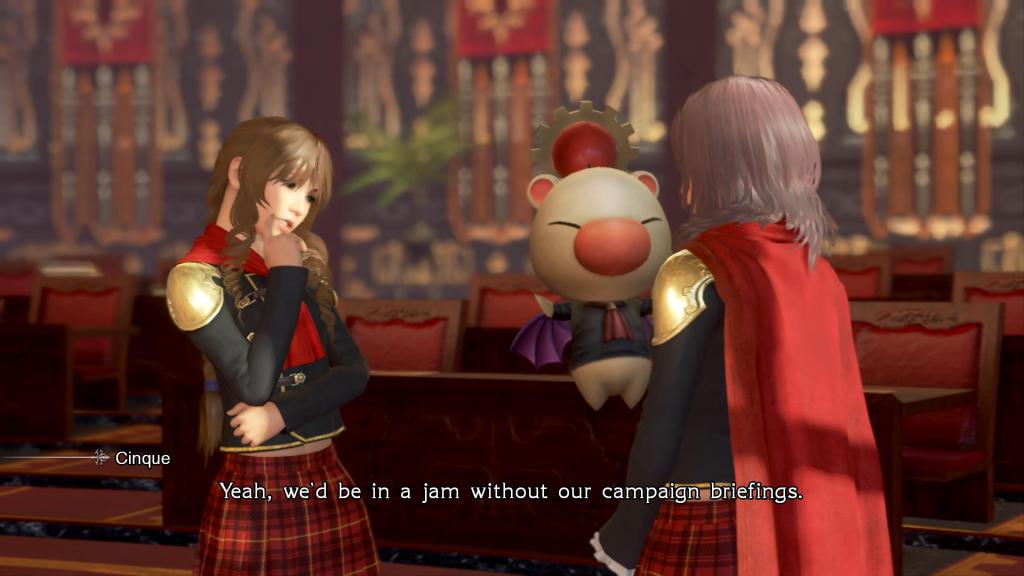
Your trusty Class Zero moogle will provide you mission briefings, kupo. I didn’t play the original but right off the bat I can say the story feels more grand than what you are actually experiencing. I feel the biggest reason is due to the fact that this game was built for the PSP, thus had to wrangle with the technical limitations of the handheld. If this were a true and proper release on the PS4/XB1, this game could have easily been much larger in scope, way more fleshed out and really been an excellent contender within the series. I’ll be honest, my initial play wasn’t that enjoyable. I found the characters to just be these generic, stock image versions of Final Fantasy characters. They sure filled the spot for a variety of classes, but they felt very empty and unlikeable. This and the linearity sort of put me off for many years. It was when I started taking serious cracks at my backlog that I revisited the game, and found that some of them had a but more growth and depth to them. Ultimately, I think that is what hurts Class Zero the most, as by the end I didn’t feel the sense of attachment to any characters that I was expecting to have.
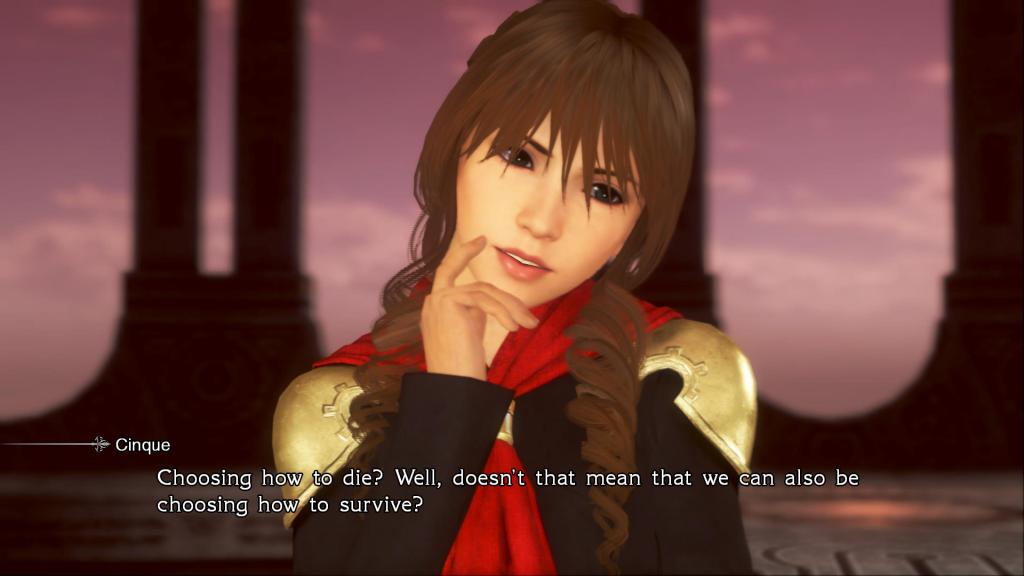
Ah yes, it only takes hours before the final fight determining the fate of the world that we decide to survive. Kids these days, always waiting till the last minute. Combat was pretty cut and dry, but it held its chops as an ARPG. You have skills mapped to the 4 main buttons, whether it be magic or weapon techniques. Each character has a unique playstyle so you can determine the character that fits you best, but Ace was a beast and he has the capacity to decimate enemies. Magic is powerful, but the system for upgrading magics just felt very bland and tacked on. You can harvest various energies called Phantomas from enemies, and these are what can be invested into different schools of magic to upgrade them. Certain enemies drop certain phantomas, and the grinding isn’t really worth the outcome in my opinion. I think utilizing the cadets’ in tandem was a much more effective strategy than focusing on magic or eidolons, which also felt very weak. One interesting aspects which very much fits into the military narrative were the overworld skirmishes. These were essentially a small strategy base defense minigame, where you are protecting your base while pushing forward and trying to capture the enemy base. Different units had different strengths and weaknesses, and the stride of battle could change suddenly, forcing you to reassess your strategy and find a different method of attack.
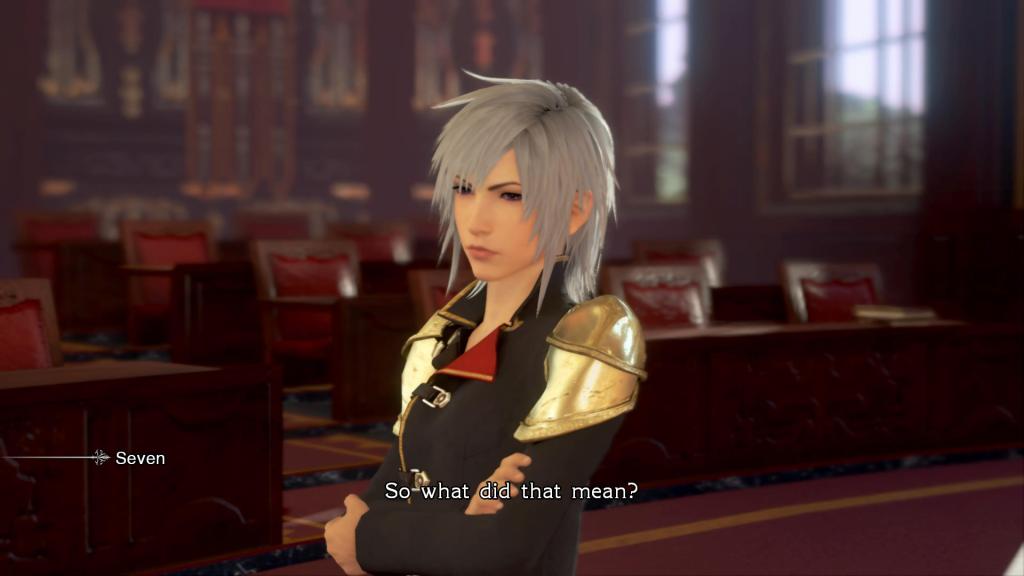
I may or may not have had a thing for Seven as the game progressed. I’m still processing these emotions, give me a break! Maybe it’s because she oddly looks like Lightning here? One aspect I really liked was the gritty feel of the cutscenes. They had these filters that gave a bit of a worn feel to them, as if they were captured on the go in battle with whatever equipment they could procure. The game itself has a nice coat of paint slapped onto some areas, and by some I mean environments of great importance, and the main characters/important NPCs. Random NPCs looked like ass, but if you are playing a visually upgraded PSP game, chances are you aren’t in it for the graphics. Aside from some silly design choices and the lack of truly meaningful character growth, Final Fantasy Type-0 HD provides a decent, albeit shallow experience for fans of the series.
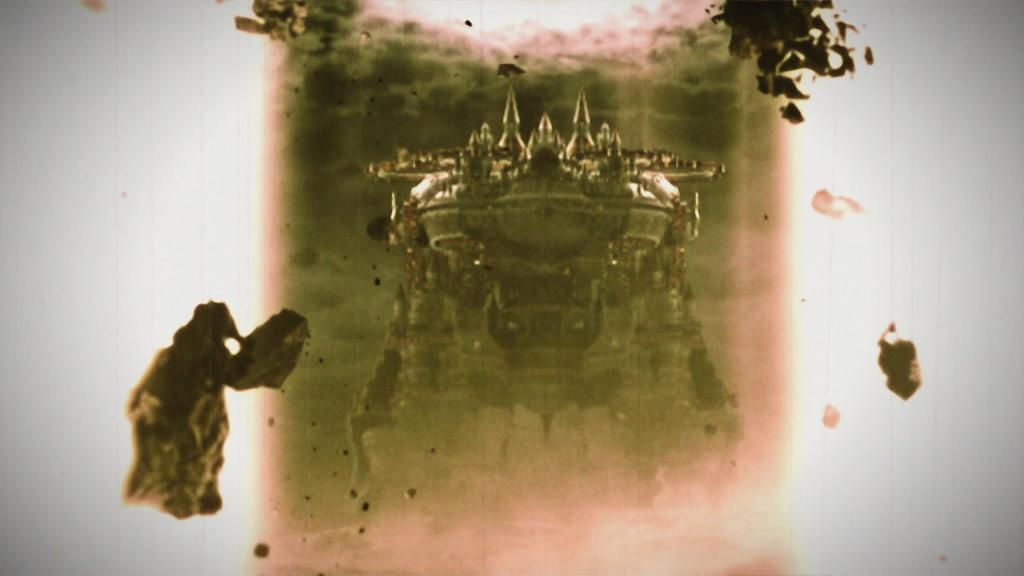
OK Alexander, your glow up was REAL, I see you.
-Game Info-
Final Fantasy Type-0 HD
Developer: Square Enix
Publisher: Square Enix
Release Date: 5/18/2015
Platforms: PS4, XB1, PC

-GamerDad Info-
Completed On: 3/20/2021
Played On: PS5
Time Played: ~40 Hours
Rating: 5.75/10
- Scarlet Nexus | Game Review
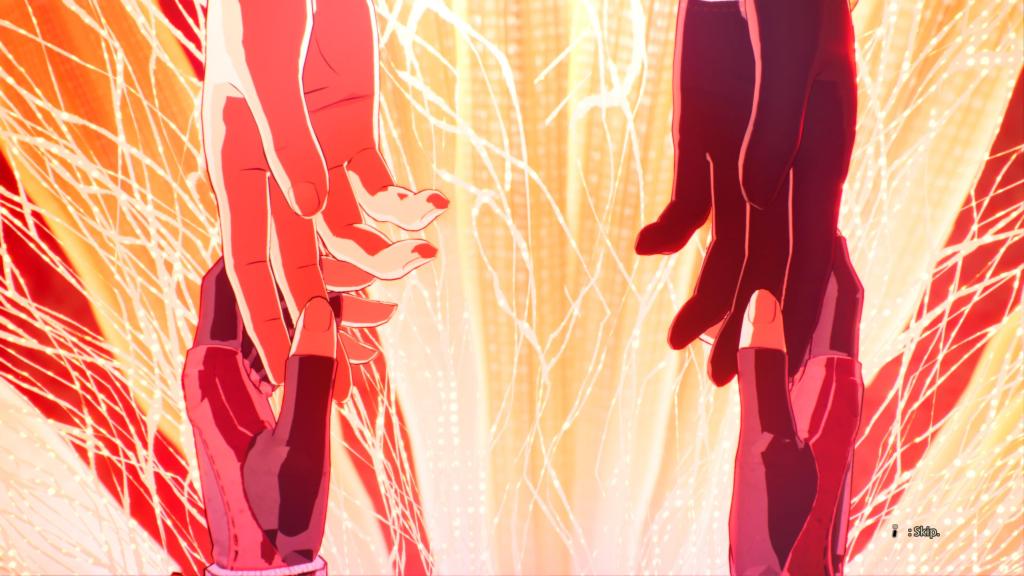
Code Vein and Tales Of Arise gave me faith in the ARPG chops of Bandai Namco, and I was quite pleased with the result. Scarlet Nexus’ brainpunk world is vibrant, yet twisted, with combat that when mastered, is truly satisfying and fun to play.
I was Straight Outta Arise when I decided to keep the Bandai-wagon going and hop into Scarlet Nexus. It was great that I did because the fluid combat of Arise more than certainly prepared me for Scarlet Nexus. I feel like a good chunk of the core influence for it it has been derived from the Tales series, yet it never seemed to dwell in its shadow.
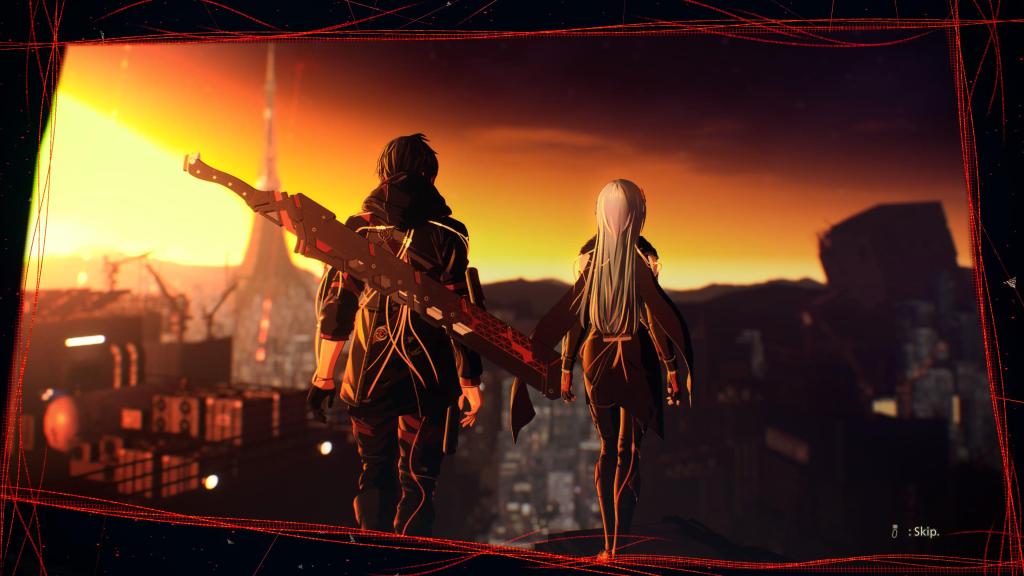
Two sides to a great story Scarlet Nexus follows two protagonists, Yuito and Kasane, as they are newly recruited to the OSF to assist in the dispatching of Others, creatures that threaten the existence of mankind. The game takes place in a sort of post-apocalypse, Neo-Japan that is technologically advanced. Humans have tapped into limitless potential by utilizing hidden powers that have been drawn out from their brains. This has imbued people with powers such as pyrokinesis, clairvoyance, teleportation, and as for our protagonists, psychokinesis. The OSF is regarded highly in society as defenders and protectors, hence the nickname Scarlet Guardians.
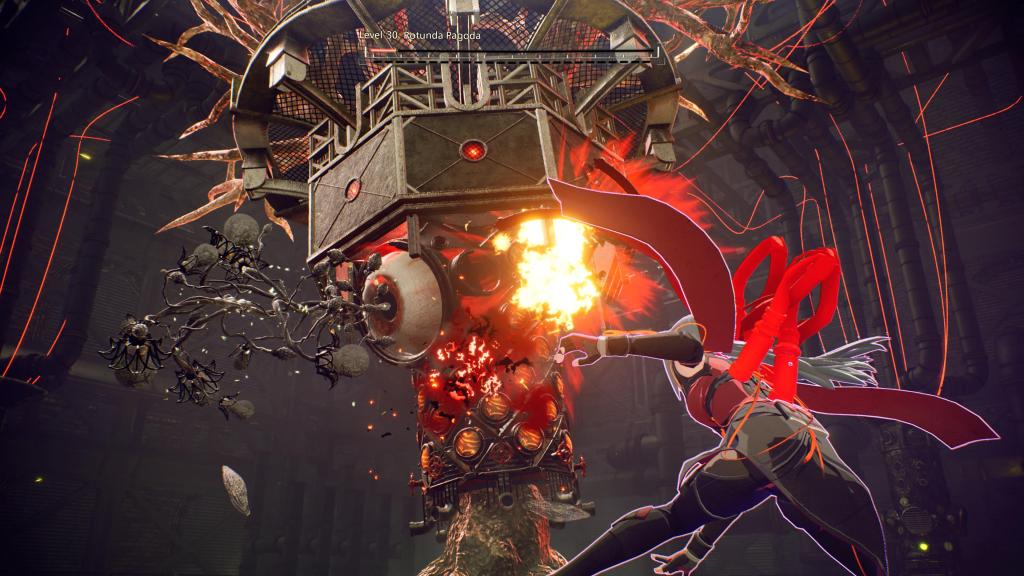
Both characters have their strengths and weaknesses, but personally Kasane was more fun to play as. The world is being encapsulated by this phenomenon called the Extinction Belt that seemingly has the monstrous Others fall from the sky, and while cities such as New Himuka and Seiran are generally safe, the outside world is pretty harsh and hostile. Not to mention, the belt occasionally lowers closer to earth, causing higher concentrations of Others to spawn, and becoming deadly. Other than that, little is known about the phenomenon, and to make matters worse, the highly advanced societies seem to have a stranglehold on information and what the public sees. Early into the story a revolution takes place that pits two sides against each other, and it serves as the foundation for the two storylines. Keep in mind, this is a JRPG, so you know things will never just be that simple!
I tend to view the story in 3 different phases. The initial phase focuses on the storyline building based on the protagonist of your choice. It features some areas that may not be visited by the opposite character, or similar areas but with different layouts and goals. The second phase is sort of a culmination of story events that lead to the parties being in an awkward “frenemies” stage, and lastly, the final phase is the assimilation of the two teams for a common goal. Yuito plays a straight arrow, he’s a caretaker for the people on his team and he is pretty morally grounded. He does the right thing because it’s in his character, and little can sway him even if it’s an unpopular decision. Kasane, on the other hand, is headstrong, a bit lacking in her social demeanor and interactions, vengeful and overprotective of her sister. This, along with the chosen paths they take as the story builds, causes their teams to butt heads on more than one occasion as they both seek the truth.
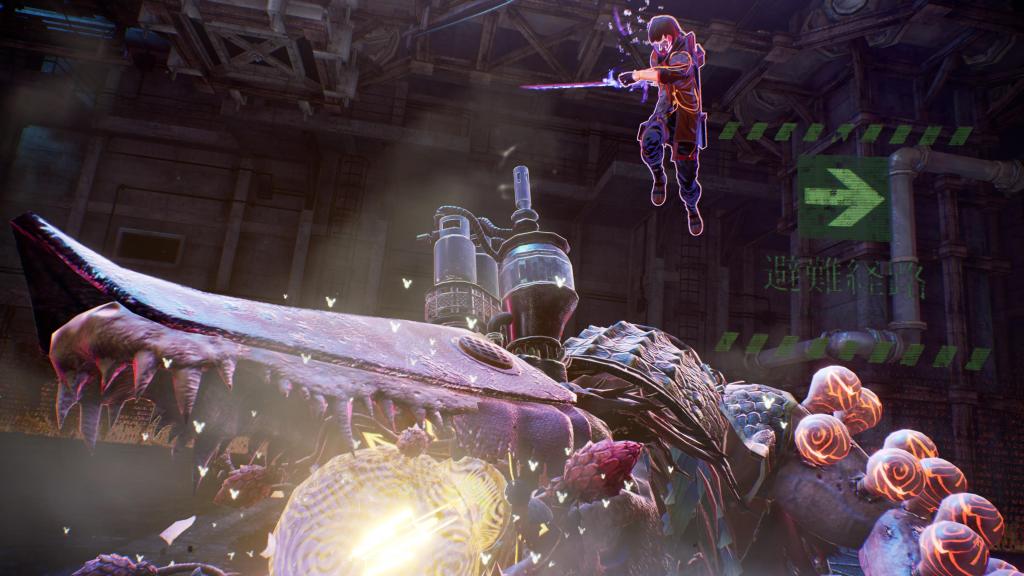
Yuito delivering one of many finishing blows. Very rarely did it get tiring seeing their…light bulbs? ripped out. Combat is far from a hack and slash affair. In order to be successful, you must learn how to utilize not only your skills, but the skills of your teammates. In Battle you can borrow the ability of your squad using SAS, or Struggle Arms System This creates unique combinations of attacks that can target enemy weaknesses, expose said weakness, or be support/utility based. For example, Luca possesses the Teleportation power, and when you SAS with him, you imbue yourself with his ability, giving yourself the ability to perform short-range teleporting directly to the enemy while attacking. This is invaluable against enemies that throw up defenses when you enter within a certain proximity. It also serves a support purpose by allowing you to teleport through certain barriers to reach hidden items or mission objectives. However, there is some latitude as to how you can approach most enemies. Luca isn’t available for most of Kasane’s playthrough, but Kagero is. His Invisibility accomplishes the same task, albeit a bit differently. This provides you with multple options on how to dispatch your foes.
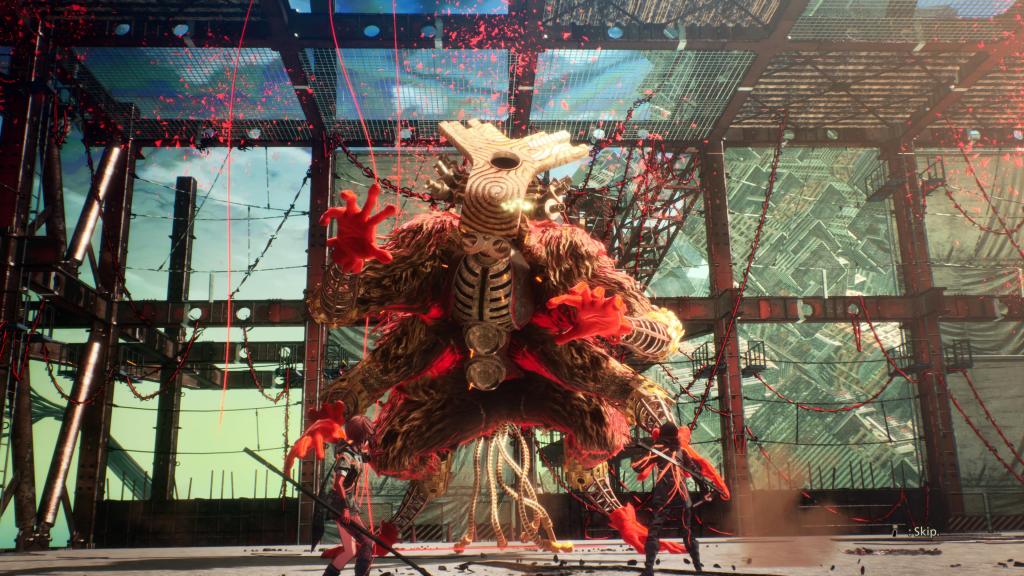
Boss fights always pushed you to utilize your combat knowledge and successfully coordinate abilities with your teammates to identify weaknesses. In between chapters you have a intermission period in which you are back at the safehouse. Here you can stock up on items, and most importantly, give gifts and watch friendship episodes. Of course these bonding episodes aren’t just for you to pretend who you want to ‘ship’ your character with, it’s really about increasing the effectiveness of your teammates and their SAS abilities. In turn, your battle effectiveness increases by being able to utilize their powers longer, or by adding additional special effects to your attacks. The hideout goes from this bland space to a thriving little hang out spot where you can see the quirks and personalities of each character shine in their designated spots. They will display all the gifts you get them as a symbol of thanks.
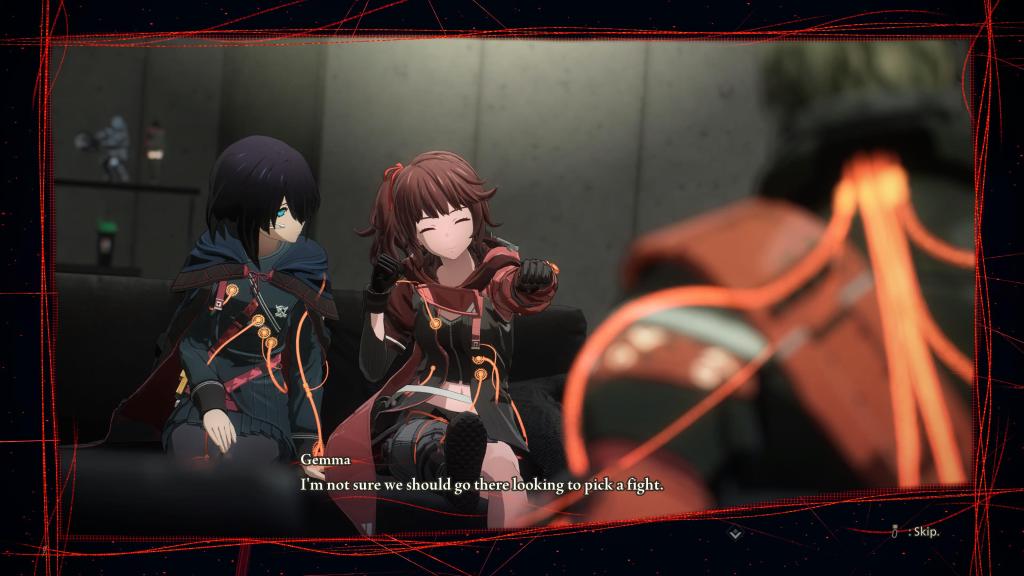
Off the heels of Arise, the friendship episodes had a very Tales feel to them, I’m assuming they drew some inspiration for it. My one complaint with the game is the whole “frenemies” thing going on. Not going to include spoilers on this one, but there are several events that take place early and mid story that cause both teams to clash and fight amongst each other. I just don’t understand how you can beat the living crap out of each other, and then…hang out with that person at a restaurant the next day? I get that they are keeping things strictly professional and not taking things personal, but there’s just some things that occur that really made me scratch my head as they brush it off to the side way too easily. Also, I felt like the conflicts between the two teams were unnecessarily dragged on in some portions just to keep the story a bit longer. I know in the moment one can be blind to other points of view, but for a group that doesn’t know what’s going on so far they did very little initially to try to reason or see eye to eye with their supposed comrades. It just felt a bit jarring at times, but overall I think it didn’t really impact the narrative. Just my two cents on the matter.
With a heavy focus on combat and its stylized look, the PS5 version excelled in all regards. Character’s and environments looked stunning, the detail was wonderful. Just the overall art style looked amazing and really fit into this concept of “brainpunk”. Scarlet Nexus delivered on all levels, and with how much Bandai seems to be investing with the release of an anime as well, one can only assume that there is more in store for our Scarlet Guardians. A sequel would be a day one purchase for sure.
-Game Info-
Scarlet Nexus
Genre: ARPG/JRPG
Developer: Bandai Namco Studios/Tose
Publisher: Bandai Namco Entertainment
Release Date: 6/24/2021
Platforms: PS4/PS5, XB1/XBS S/X, PC

-GamerDad Info-
Completed On: 9/27/2021
Played On: PS5
Time Played: ~80 Hours
Rating: 7.75/10
- Dungeon Encounters | Game Review
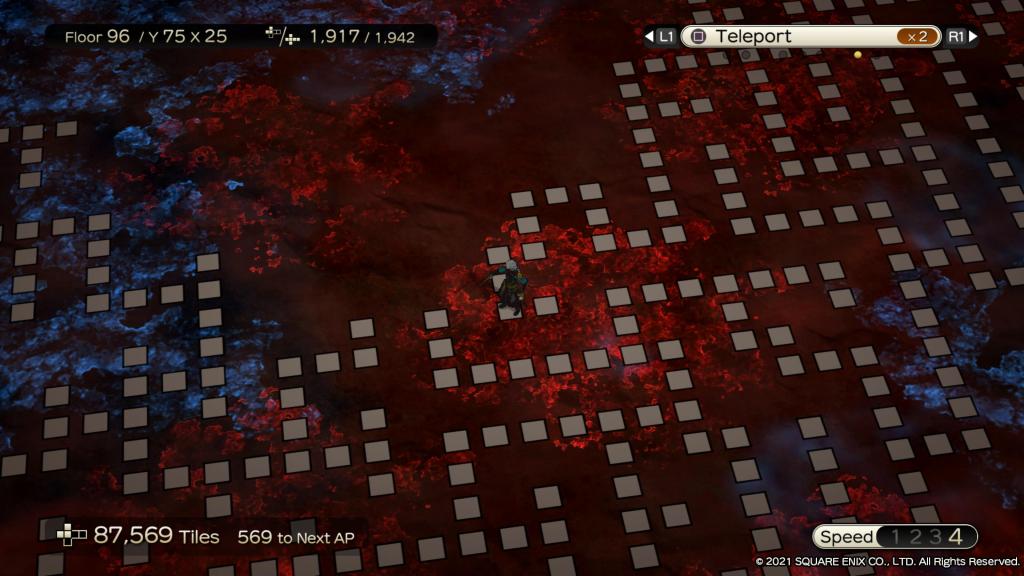
Dungeon Encounters is the latest adventure that dives into the world of dungeon-crawling, but don’t let the minimalism fool you; simplistic yet artfully balanced, this game will have you constantly pushing for “one more floor”. Square Enix has a hidden gem that I’m begging for them to capitalize on.
Dungeon Encounters really caught my attention when announced probably for the same reason everyone is think. It seemed very barebones and shallow. But I’m a huge sucker for the blessed offerings of Square Enix, so I trusted in the fact that they have rarely led me astray. A group of oddly named adventurers have gathered at The Academy, serving as the headquarters for the journeys ahead. Each character comes with a blurb that serves as a synopsis of their story and what drew them to the depths of the dungeons. Some came to seek a challenge, for others it was fortune and fame. Some were alluded by its mystery, and others are just a fat cat and a dog with a sword in his mouth. Just like the dungeon, don’t pass this one up because on face value it looks plain. There’s a real treasure of a game here and it becomes apparent as you find yourself wanting to delve deeper.
No frills or fanfare, just you and the crew versus the dungeon You begin with your selected party of four (slim pickings early on), and since you’re broke it’s time to ignore the shops and head off. There are a litany of enemies, traps, status effects, and…tiles, between you and the superboss below. The core mechanics of the game are slay enemies, uncover tiles on the floor to locate the stairs, and descend. Occasionally, you will come across treasure chests which may have gold or a valuable item, map riddles, or in-dungeon shops that are not accessible on Floor 00. You will lack quality gear and abilities at first, which makes it beneficial to safely explore as much as you can. Safety is the key, as Dungeon Encounters can be unforgiving. Battle is turn based, in which you are utilizing physical attacks or magic, ranged or melee. When you strike an enemy with a physical attack, their Physical Defense will incur damage. Once at 0, they will take HP damage. Same goes for magic, and the same applies to you. Some enemies can ignore defense and have HP attacks, so it’s best to stay healed.
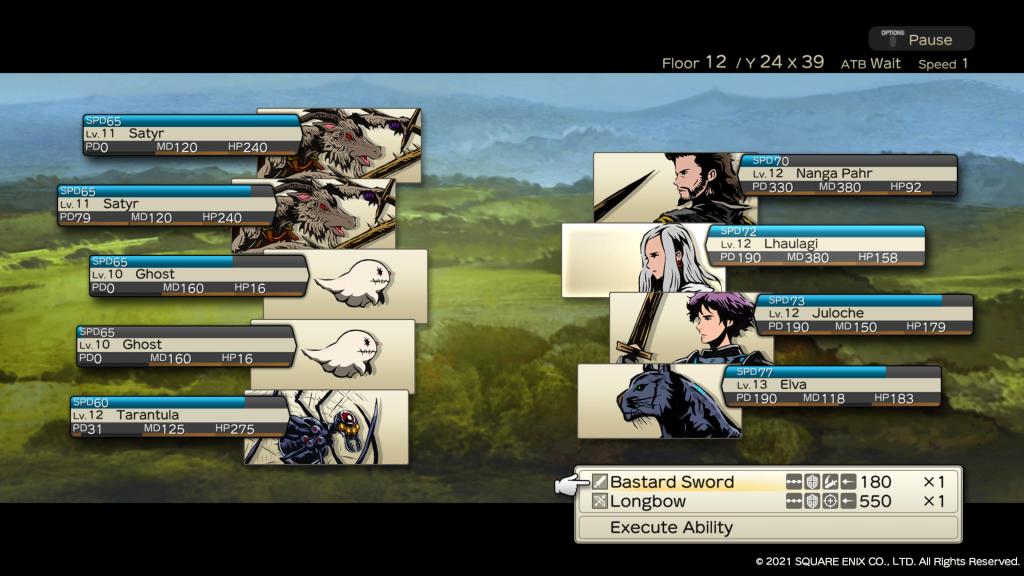
My first party that I lost to the abyss, RIP. By the time I got them back they were underleveled and severely outgeared. Every 10 floors is a new region in the dungeon, which changes the background that the tiles are overlaying. Each new region is usually also introducing a new mechanic of some sort, such as pitfalls, tolls, hidden tiles, and “islands” of unconnected tiles. They range from annoying to downright deadly. Tolls can put a serious dent in your wallet if not careful, but thankfully an ability called “Toll Evasion” will avoid the costs. Hidden tiles can lead to some great loot, shops, or just provide a shortcut to an exit, but without the ability “Illusion Clairvoyance”, you’ll find yourself scrambling all over the layout in hopes of running into some. Islands can be reached using various abilities such as “Shift” or properly positioned “Lesser Ascension/Descension”. Pitfalls…just no. They will drop you until you come in contact with a tile below you. In theory you can drop down to the 99th floor but A) that’s a terrible idea without the ability “Teleport”, and B) if there is no tile then your party will get tossed into oblivion, and scattered randomly within the 99 floors. If you do not have a kitted out arsenal of abilities, this could leave you screwed. Going up or down a floor will cause pitfalls to move, so if you are going for 100% on that floor, don’t jump into the abyss.
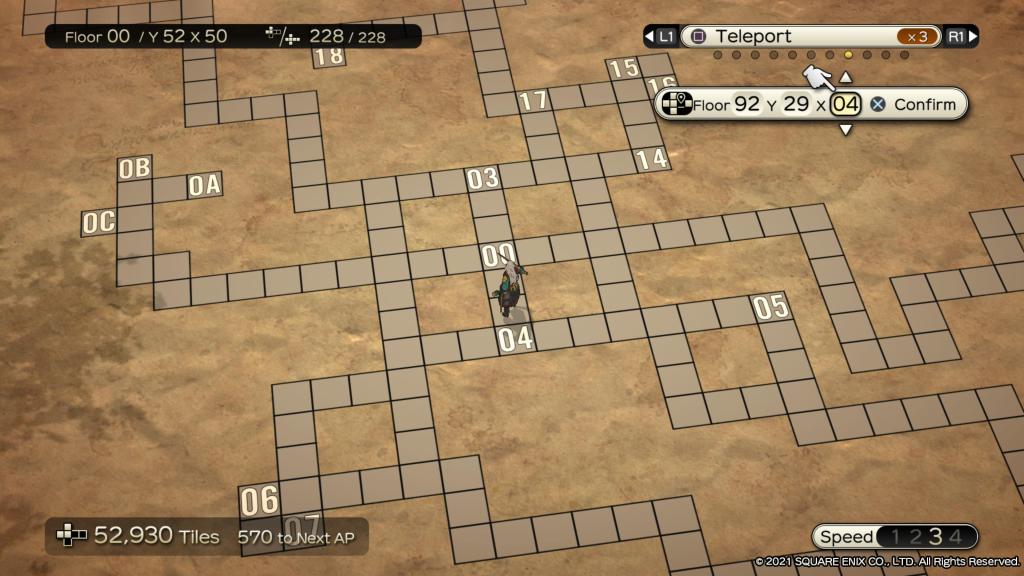
Use extreme caution when teleporting. You just might teleport your entire party into becoming lost, Wandering characters. Having to find an entire party that is probably randomly spread around 99 floors with most likely your best gear…not fun Characters can equip anything, so long as they have the points to do so, or PP. Better equipment uses more PP. It will usually increase as you level up, so a bit of prior floor grinding can pay off by having you enter a new area with plenty of PP to spare, and snagging a weapon drop that is an upgrade from your current gear. Money will come as you play, but a great way to get gear is simply Defeating enemies. You might even get lucky and get a drop that I’d a couple of notches above your current gear. As long as you have available PP to equip it, then anything goes. You are forced to have a balancing act of sorts, choosing between ranged weapons, magic, melee, and a variety of status causing weapons. Armor and all of that too, don’t forget! So a balance is necessary. You will learn which enemies can wreck you, and which can be put off till last, but as you play you will formulate your own strategies on how to go about clearing the dangers ahead of you. To assist in dungeon clearing, you are awarded Ability Points when you clear the map (anywhere from 3 to 5), and when you hit certain Tiles Cleared milestones. Don’t neglect getting 100% on earlier floors, as these points can make a huge difference in your battle capabilities and traversal prowess. The true capabilities of your journey are unlocked when you have a vast array of abilities coupled with solid gear. It makes it possible to even take on stronger enemies, and gives you much more of a fighting chance in those high risk/high reward encounters.
If you die, the end isn’t necessarily near. You will begin back at the Academy, and be prompted to choose a new party. Your old party will have the KO status at the exact tile you met your demise at. This can be cumbersome and deadly if you have a fresh, unleveled party of scrubs, and boy I learned this the hard way. You need to travel to the location where your party died at, swap them into your party, and then find a Ressurection Shrine to bring them back. Early on, this means many dangerous trips, but once you have a good repertoire of abilities and leveled characters it’s much less daunting. That being said, don’t be afraid to level a bit with enemies you can safely dispatch, and ALWAYS err on the side of caution. The ability “Greater Descension” is like your own personal pitfall, so it would behoove you to consult guides on where it is safe to do so, as you may very well drop yourself into the depths of nothing. “Teleport” is another useful ability, and again, teleporting to a tile that doesn’t exist will cause your party to get yeeted into who knows where.
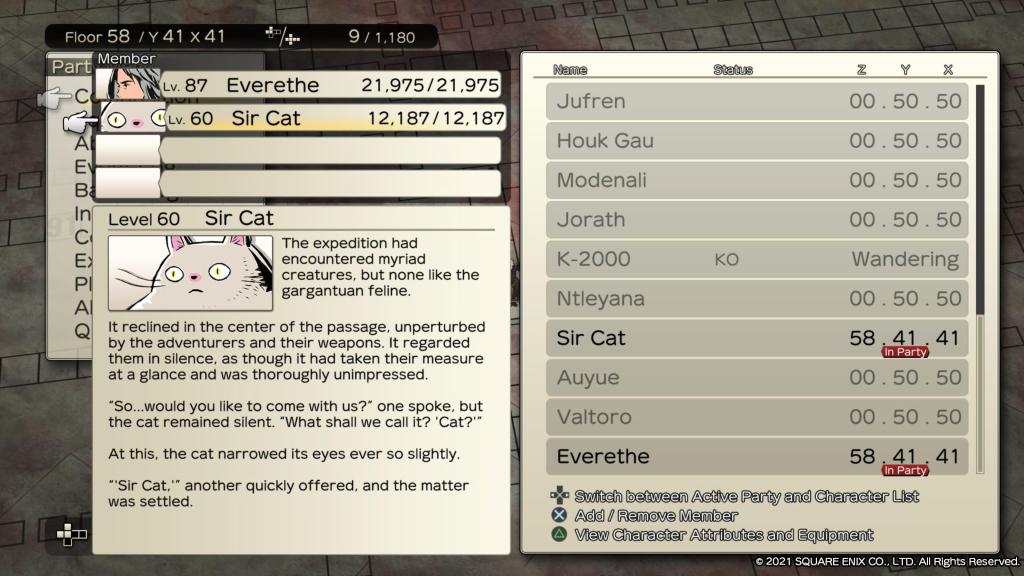
I dub thee Sir Cat. Oh, and Pro tip: USE YOUR LOGS! The Event log has a vast list of enemy info spots, shops, altars, teleporters, etc. Of course that is they only show the location once discovered. But if you wanna go back to the shark shop, once you find it you can easily Teleport back without issue. Another extremely useful log is the Battle Log. Every encounter has some sort of hexadecimal value. See a weird number on the floor in front of you? Look it up. As the numbers get higher, the enemies are stronger. 01 is weak, 99 is strong, and FF is at level 255 with over 2 million HP so stay far away. Dungeon Encounters favors the smarter, cautious play instead of the charge in full steam approach.
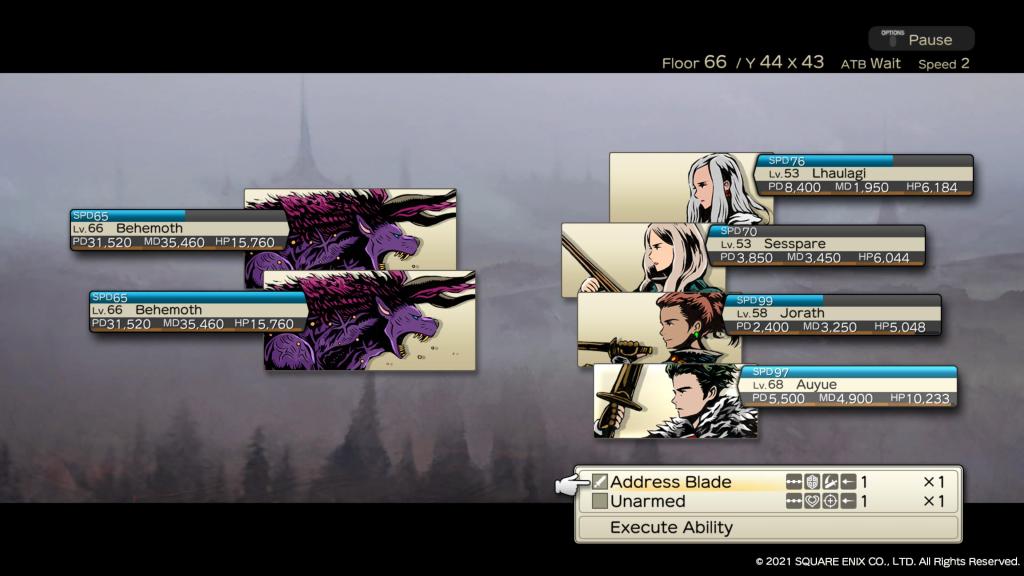
The Address Blade, a hidden weapon with an obscure message displayed before receiving it, and strange but OP damage capabilities. You WILL want to teleport to this bad boy here *slaps hood* Wayne was right. Women lie, men lie, numbers don’t lie. The number game of Dungeon Encounters can be a bit daunting at first but if you can appreciate a mechanically-sound game, this will not disappoint. I will imagine that this title isn’t for everyone. If you can’t get passed a game not having an intricate plot or Ghost Of Tsushima-esque graphics than you will be disappointed, and shame on you. Dungeon Encounters is truly greater than the sum of those parts. I was skeptical at first, but something about the minimalism struck a chord with me, and the dungeon hungers for you to explore it more and more. I can’t hang the way I used to, and very few games have me staying up very late to get some progress in, but Dungeon Encounters managed to have me enthralled until 4:30 AM, out of Ressurections or Restores while stuck on Floor 65 and I loved every moment of it.
-Game Info-
Dungeon Encounters
Genre: RPG/Strategy/Dungeon Crawler
Developer: Square Enix
Publisher: Square Enix
Release Date: 10/14/2021
Platforms: PS4, NSW, PC

-GamerDad Info-
Completed On: 10/23/2021
Played On: PS5
Time Played: ~50 Hours
Rating: 8/10
- Returnal | Game Review
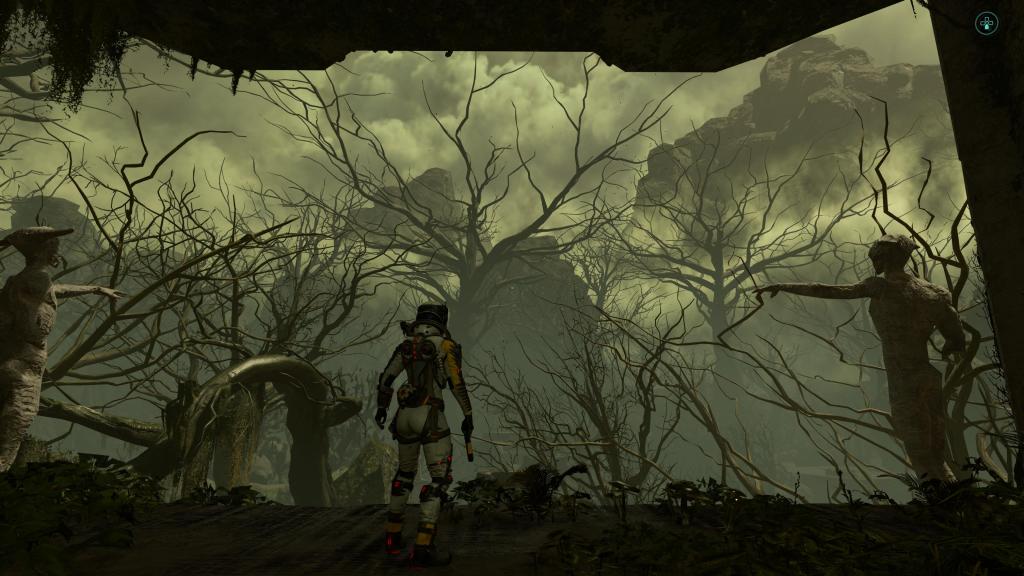
If you can triumph over the save limitations, Returnal is flawless in delivering satisfying combat, endless builds to help you expose the truth of Atropos, all brilliantly fused with a drip-fed psychological narrative.
As much as I have dipped my toes in other genres lately, my bread and butter is the RPG in its many forms and fashions. Shooters? I’m pretty bad at those, and really don’t hone the skill for them much due to most of the games having never-ending content to where it’s overwhelming. Destiny 1 and 2 are sort of an outlier for me, as well as Borderlands. But they satisfied another aspect I enjoy, which is the loot. Another genre I’m not that well-versed in are roguelikes, despite liking the concept of them. So what happens when you put the two of them together?
Well, you get what might be my favorite PS5 exclusive thus far.
Returnal combines a tight, responsive shooter, with an ever-changing world that will revolve around your death, over and over again. Housemarque did a damn good job with the environmental storytelling, and the drip feeding of lore and contextual information that keeps you guessing what on earth, I mean Atropos, is going on. You play as Selene, a woman with heterochromia, who is an astronaut with the Astra Program. You discover a signal coming from the forbidden planet Atropos. As you are navigating the storms, your ship, Helios is struck down. Get familiar with seeing poor Helios hit by a Thundaga, cause you will be seeing it ALOT. Surviving the crash, Selene explores to discover the body of another scout here before her. But wait! The scout is actually her dead body. In comes the loop.
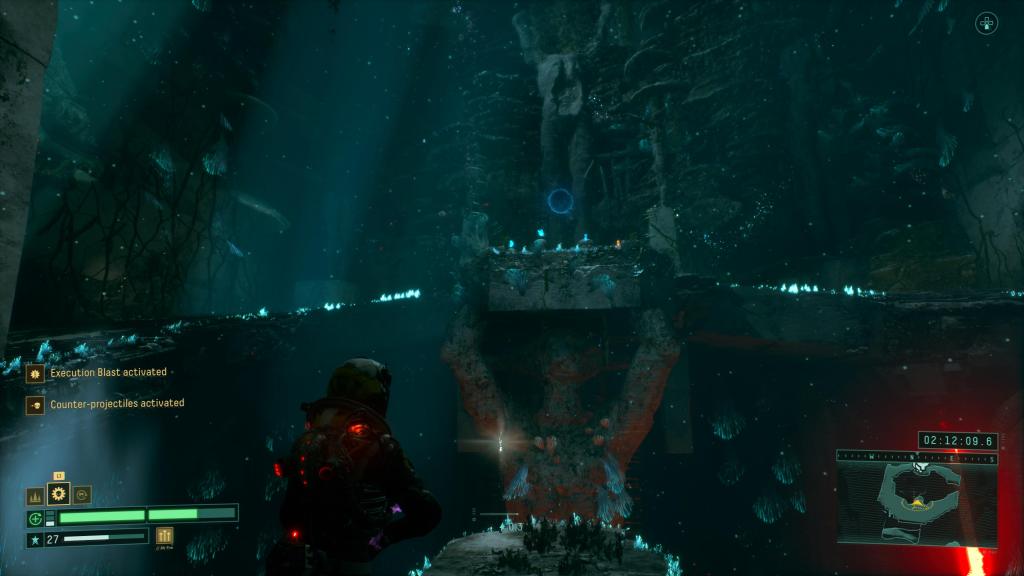
This was one of many unsuccessful runs Dying is pivotal to Returnal, as some scenes or tidbits of lore will not be dished out until you die X amount of times, or a certain way. Luckily for you, you will probably die a decent amount of times anyways. I want to say off the bat that the game isn’t hard, but it can be very challenging. It becomes much more manageable once you learn your enemy’s patterns, their strengths and weaknesses as well as your own. Your weapon loadout is crucial to this as well, as a weapon with some neat perks can make you a walking deathmachine. My personal favorite was the Hollowseeker + Serrated, Portal Beam, Portal Turret, which just led to a joyous cataclysm of energy beams and laser beams from magical portals. What a treat to watch. Speaking of loadouts, having builds that are in sync with the way you play can make a huge difference. No sense in if you are a heavy melee user that you should be picking up a parasite that has a decent positive effect, but the negative is -50% melee damage or adverse affects to its cool down. I found myself creating some interesting builds, such as keeping malfunction-repairing items in my inventory plus parasites that improve integrity.
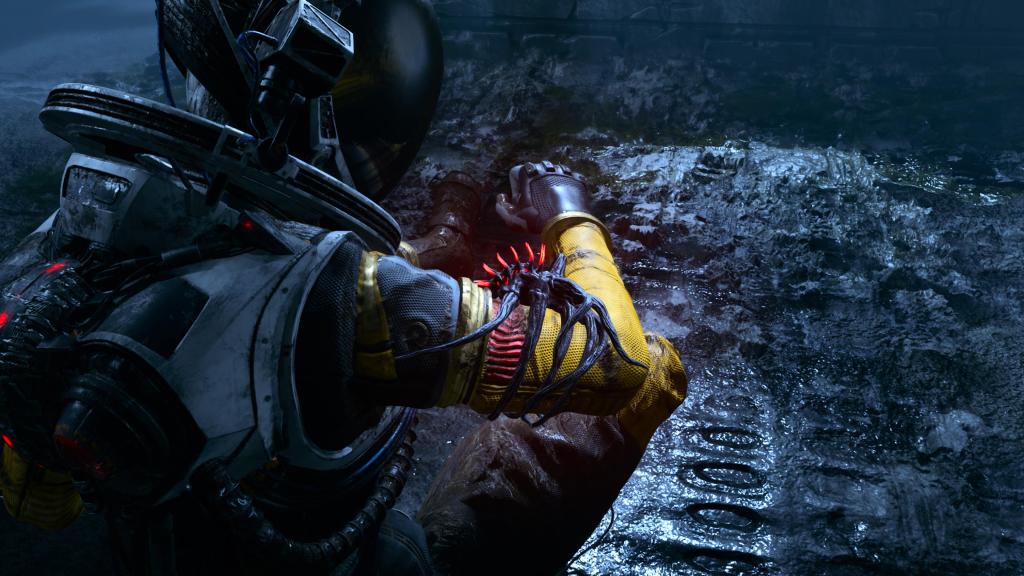
Cute lil’ parasite, casually merging with my arm Returnal is bossy. It’s not generous like other games where every 15 steps an autosave icon appears, or checkpoints being thrown around like Covid stipend money. It demands your time and effort, and rewards you with doses of worldbuilding. Who is Selene? Why are you stuck in this time loop? Why is it ever changing? As time progresses, it seems even the fundamental aspects of Selene herself are called into question. It demands you are cautious and calculated, fearing every encounter in every chamber. Eventually, you’ll find yourself on one run where you’ve realized that the fear has subsided and it begins to feel almost divine to know that you are the one they fear in the chamber. Playing Returnal in bits and pieces is great to soak it in slowly, but it shines when you are in full command of it and make your enemies bend the knee.
Still, this game might not be for everyone. Due to the lack of saving ability and the fact that there’s really only two checkpoints, Returnal can feel very daunting or nigh impossible at first. I believe that Housemarque built the game concept around this, and to change it would certainly alter the difficulty and way the game works, but realistically for many people this is the barrier of entry for them. I can’t tell you how many times I had those butt-clenching “oshitoshitoshit” moments while rocking one of my kids to sleep. Multitasking at it’s finest. Yet, I’m very aware that this just simply doesn’t work for everyone and whatever responsibilities they have. If you can muster up the determination and challenge this game, I’m sure you will eventually triumph. It was awesome to not only get confident in taking enemies on, it was a rush once all of the mechanics melded into one and the game shines the way it is meant to be. Hands down, this is a fantastic game that I hope everyone has the chance to play. Housemarque did an excellent job and I wonder if we are in store for more Returnal content or a sequel maybe? I’ll dream on a bit.
SPOILERS Below:
I found that the game structure itself was a play on the entire concept of the story. Dying and looping, you become an extension of Selene. As she is stuck, so are you, constantly putting in one more run, or one more room in hopes of finding that perfect artifact and/or parasite. Initially, the story is cryptic and vague, but ultimately we are faced with a story of tremendous loss, pain and trauma. It’s a bit puzzling to determine what is true, and what is actually going on, as it’s clear that Selene may not be who is. She disobeys orders and flies to the signal being broadcasted by Atropos, but upon further analysis of scout logs, Selene apparently never made it into the Astra Program. These logs begin to give more details about every different experience that another “Selene” has had before they met their untimely end.
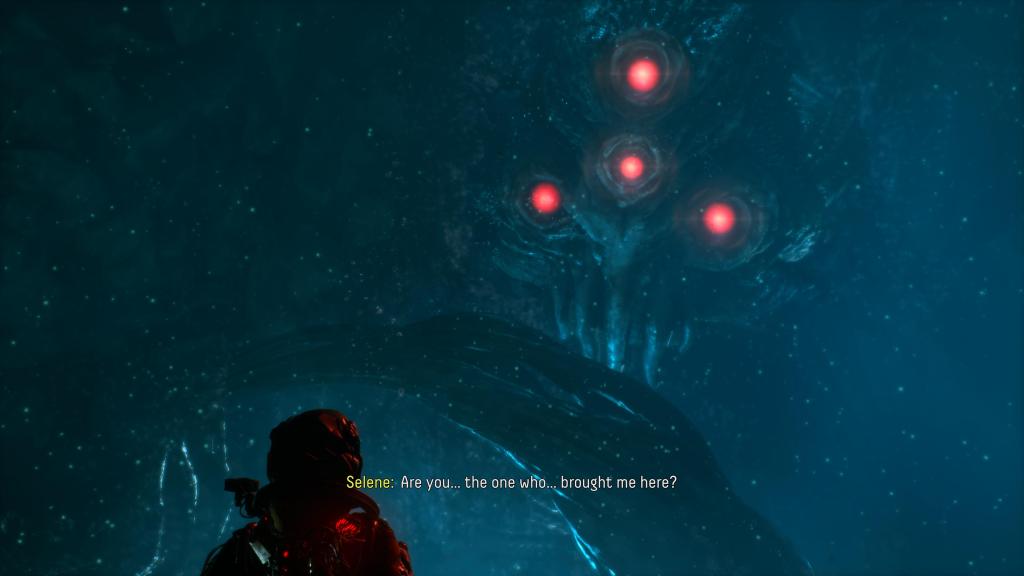
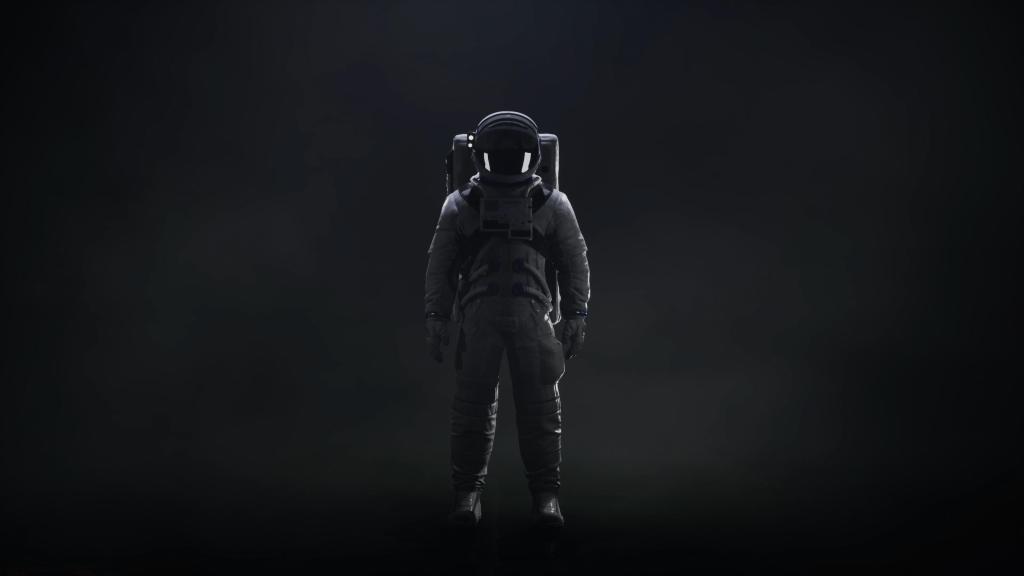
Helios also has significance in that its basically the only name for the child in the house, which coincidentally is the name of the ship. Helios the ship is shot down, and paradoxically its determined that you are the one that shot it down, thus constantly ensuring your loop continues on Atropos. I believe that this shooting down of Helios, and the car scene in which “Helios” is in the back seat, all represent the the moment of trauma and grief that the woman who clearly looks like Selene is experiencing. Cues in-game suggest she’s mentally unstable, on medications, and the home life is not a happy one. It’s not farfetched to assume that maybe she was driving and just…lost it. The car dives into the water and Selene is clutched, transported to Atropos by tentacles (oddly like the final boss..confronting your grief/acceptance perhaps?). This theory makes more sense when the additional ending implies that you are the astronaut. This changes everything because it is you haunting yourself in the replica home, stalking yourself and just being this foreboding prescence. Ultimately, Selene Vassos is the reason for her own destruction, and her trauma and shock has forced her to relive the events over and over, always ‘Returning’. Of course, that’s just my interpretation of it, but I feel the layers of metaphor and comparisons make it so easy to speculate and come up with theories.
SPOILERS End
-Game Info-
Returnal
Genre: Roguelike/Third-Person Shooter
Developer: Housemarque
Publisher: Sony Interactive Entertainment
Release Date: 4/30/2021
Platforms: PS5

-GamerDad Info-
Completed On: 5/15/2021
Played On: PS5
Time Played: ~70 Hours
Rating: 9/10
- I Am Setsuna. | Game Review
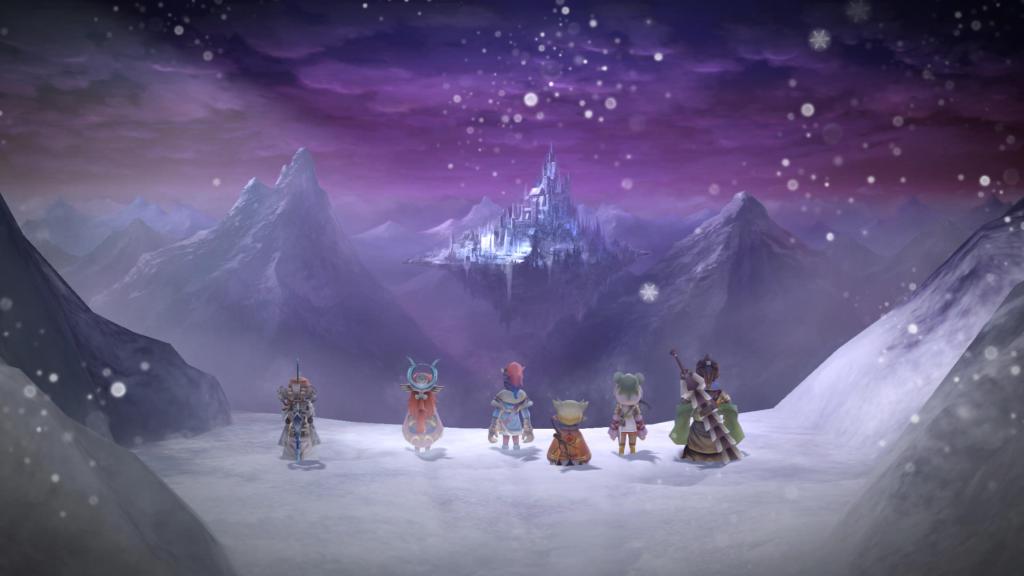
A love letter to JRPGs of yesterday, I Am Setsuna takes a fated group of travelers on a pilgrimage to bring hope back to this land of snow and sadness.
Endir is a mercenary who is tasked with dispatching a few monsters and saving a girl when a mysterious man appears before him and has a clear objective for his bombshell of a new job: kill Setsuna, the girl who will travel to be the Sacrifice.
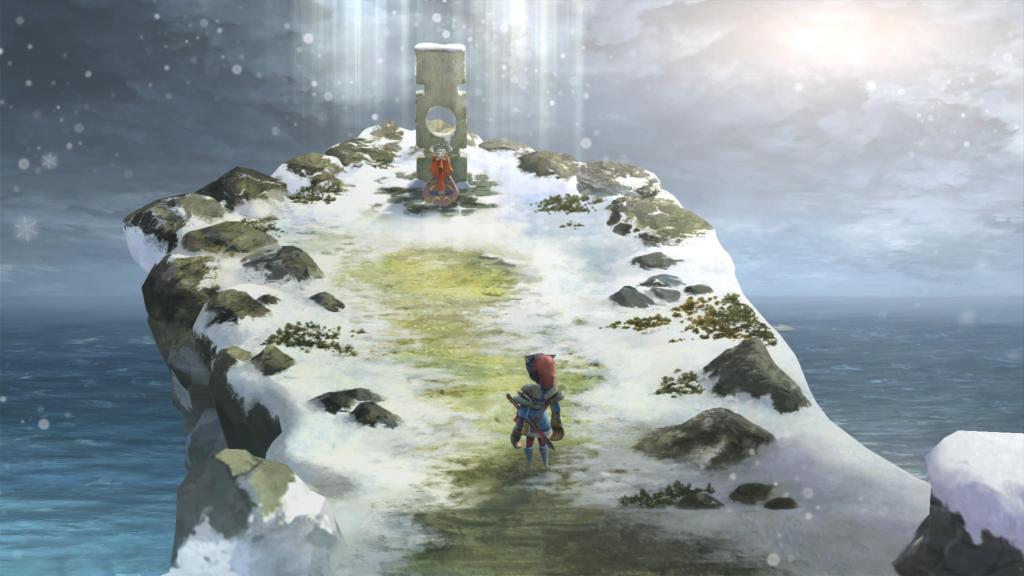
*Insert “Jaws Theme” here* The best way to explain it would be to compare it to Final Fantasy X where Tidus and gang accompany Yuna on her pilgrimage to Zanarkand. The Sacrifice is a chosen individual who makes the journey to the Last Lands about every ten years, to offer her life in exchange for years of peace. The ritual seems to quell monster insurrections and therefore, has become a tradition dating back hundreds of years. Just as her mother before, Setsuna is preparing for her journey when Endir happens upon her. Hesitating to act out on the task that was given to him, he is taken by the townspeople. Yet Setsuna, out of all of them, shows him compassion and forgiveness. She seems to have deja vu and find him familiar and comforting, and makes the case to have Endir join her guard. A woman named Aeterna is also recently made part of her guard, and she seems to know more than she is initially letting on.
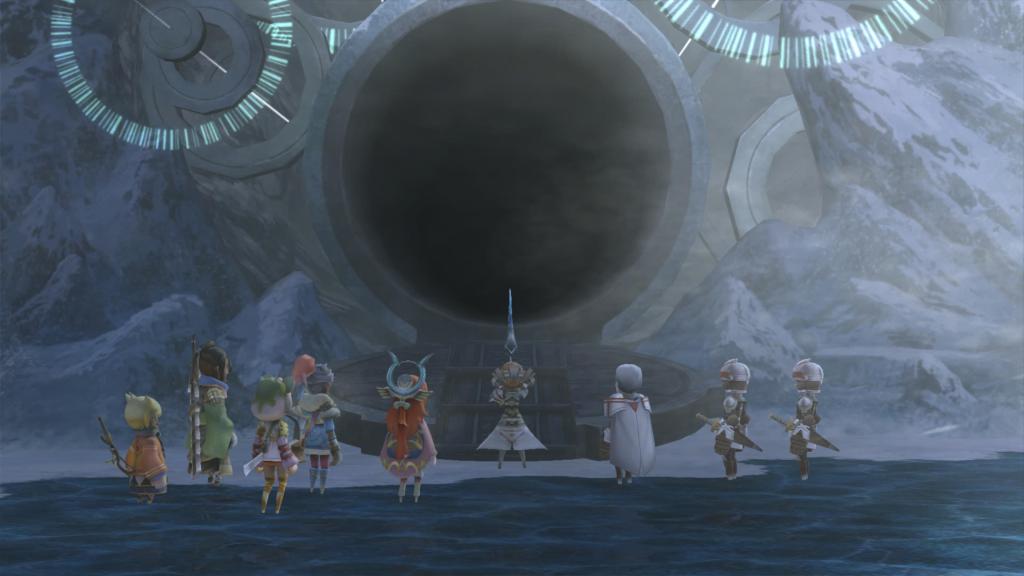
Right off the bat there is tension within the party, as Aeterna does not trust Endir (the guy had pre-meditated murder in mind, makes sense), yet Setsuna defends him and appreciates his presence. As the party continues and grows, each new member brings along new insight as well as new baggage, eventually forming a microcosm of the world around them and ultimately, the world that they wish to foster anew. Deception and evil have become more commonplace in the world of I Am Setsuna, and the hopelessness of Man is further exemplified by the consistent snowfall. In that sense, I interpret the snow as a metaphor. It’s beautiful and pure, yet cold and deadly. I think that perfectly encapsulates the morose, somber atmosphere surrounding the land. Monsters are growing more cunning, employing tactics and maneuvers, rare-bloods are being kidnapped and used as bargaining tools for trade and other shady activities, people are possessed and driven mad by their own ego and blind faith, etc. You get the picture. It’s not a happy world, yet the snow at times makes it all feel, for lack of a better word, frozen in time. All the ills of the world seem to just fade away as you are looking over the ocean into the snowy horizon watching the flakes dazzle the screen.
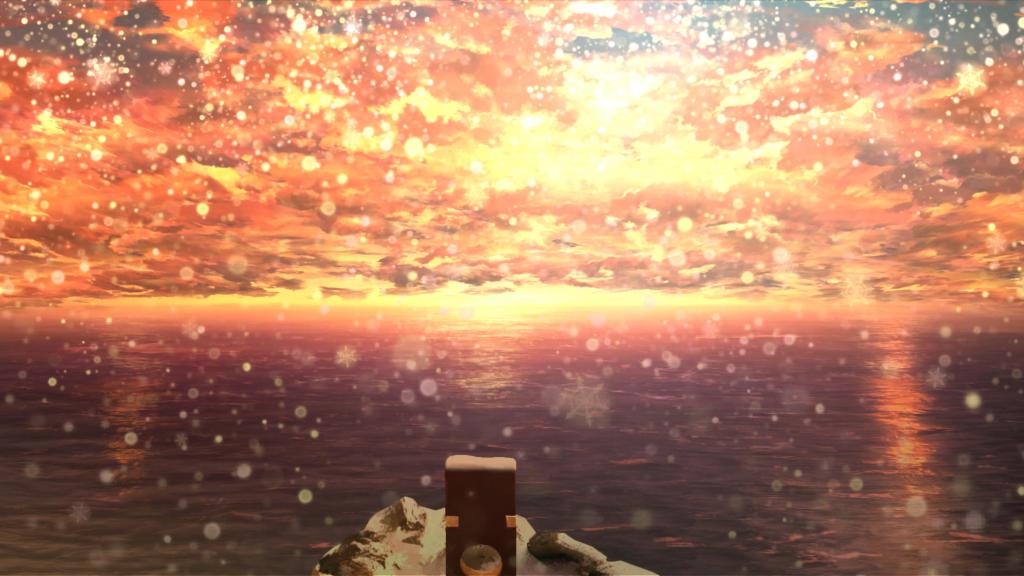
The buildup to this moment was beautiful. Everything is so bleak so to see the vibrance and color peer through the sky was almost cathartic For what it’s worth, I Am Setsuna is not a revolutionary game. It does not challenge the genre in any meaningful way, or attempt to subvert player expectations. It stays predictably in the middle with just about everything. While I understand the entire world is snow covered, the towns and locations themselves seemed to have little variety and began to feel too similar. The lack of an in-game map normally wouldn’t be so much of an issue given the game world isn’t massive, but the damn snow makes everything look identical. Game-breaking? No, but can be pretty frustrating. Despite the shortcomings, I’m ok with the way it was presented. It was exactly what I thought it was going to be, a calm journey and a reprieve from exposition of loud, over the top JRPGs. Don’t get me wrong, I love those just as much, but this was soothing to play, flaws and all. The pilgrimage uncovers multiple truths and lies about the nature of the world, the past, mankind, and the true purpose of the sacrifice. Perhaps Setsuna’s calm, caring disposition reminded me of Yuna, and while Endir doesn’t have much of a personality, he seems to soften up from her influence as well.
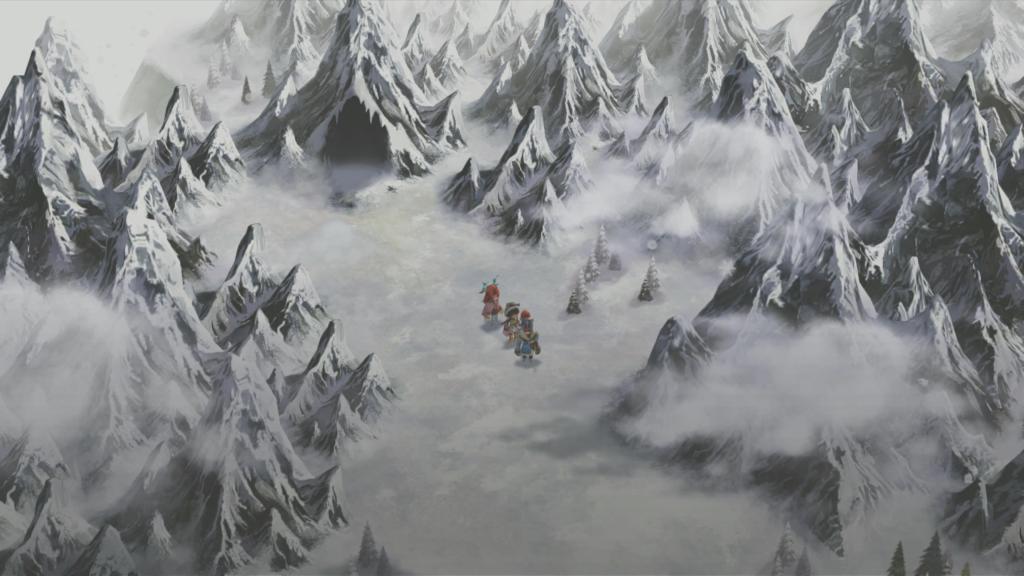
No, not that snow-capped mountain with a cave, I need to go to the OTHER one. SPOILERS AHEAD.
Once Cornelius reveals himself, it just..stops? There’s no follow up? This man proposed the insane job of killing Setsuna, supposedly given to him from higher powers, and when you and the party are face to face with him, Endir has 0 reaction to all of it? It just makes no sense to me, and every moment of Cornelius having concern for anything in the slightest just felt fake and forced. How can he care about the safety of Julienne when he is initially pushing you to kill Setsuna, thus dooming the entire world to utter destruction? I also believe the Nidr/Setsuna dynamic was poorly conceived. Given his love and reverence for Mana, he couldn’t be there the way he should for their child, instead delegating himself to just be her bodyguard? His side quest touches on it a bit but even then, I feel like he progressed so much during the game in conquering his regrets and deficiencies, just for one man to strike him down to being second-rate. I found it odd, and as a dad I would think that there would be less hesitation to want to be there as the father figure.
I Am Setsuna may not exceed your expectations, but it is a safe bet. A relatively short story that touches on multiple themes and leads a decent cast of characters down familiar paths. For me, it served as a great escape from some lofty JRPGs I’ve been playing recently. I will have to check out some more works from Tokyo RPG Factory and see how they compare.
-Game Info-
I Am Setsuna.
Genre: JRPG
Developer: Tokyo RPG Factory
Publisher: Square Enix
Release Date: 2/18/2016
Platforms: PS4, Vita, NSW, PC

-GamerDad Info-
Completed On: 10/17/2021
Played On: PS5
Time Played: ~35 Hours
Rating: 6/10
- Nexomon | Game Review
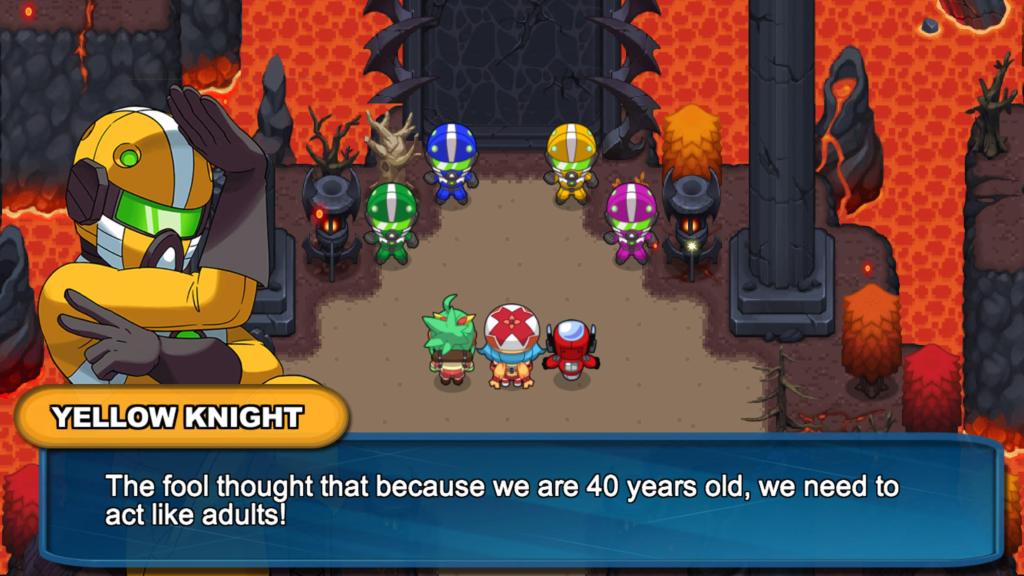
Going from Nexomon: Extinction to the original can feel a bit lacking in features, but this port could be a sign of a promising future for the series
I played Nexomon: Extinction and kept my expectations low: it was a mobile game basically, and those do very little to capture my interests. However, the catch em’ all genre is home to a relatively select amount of games. Most of them happen to be Pokémon, and they are all Nintendo. I don’t have a Nintendo console to get my Mon fix, so I figured Nexomon would be a nice reprieve from the withdrawals. Safe to say, I thoroughly enjoyed it. Fresh designs, humor a plenty, it didn’t take itself seriously and that was such a good part of it. So learning about the port for One, I had to get back into my Nexotrappin’.
Nexomon One starts off with your MC leaving home and stumbling upon your friend Ellie and her 4th wall-breaking robot Atlas. You bump into shady looking characters and get into a Nexomom battle, selecting your starter in the process. A very, very douchey guy called the Nexolord comes to visit your parents, and pretty much threatens you. He’s very clearly the bad guy, and the game usually avoids any subtleties with things like this. Atlas becomes your companion, as you journey the lands investigating the Nexolord because he’s very obviously up to no good. You take on the Nexomon equivalent of gym leaders, called Overseers. They each have their quirks, but it seems for the most part people do not like the Nexolord and his oppressive Overseers, but they also have accepted the fact that they are too powerful and stay complacent. You journey to each land, challenging the Overseer to hopefully get some details on the Nexolord’s scheme, and find yourself embroiled in a plot to bring about untold destruction to the world.

They are all terrible people Pokémon lately has become…disturbingly easy. In fact, I don’t think I’ve ever felt significantly challenged in a Pokémon game. Early parts of Red and Blue had some challenge to them, but back then everything was new so I didn’t know what to expect. You can easily steamroll vast portions of the game with overleveled Pokémon. Nexomon doesn’t play by this rule, a full varied party is essential. Each type has two weaknesses and two strengths. Interestingly enough, types are not resistant to themselves. So if your Mineral Types are wiped out and your opponent swaps a Fire Type in, go ahead and use your Fire Type, you’ll deal normal amounts of damage.
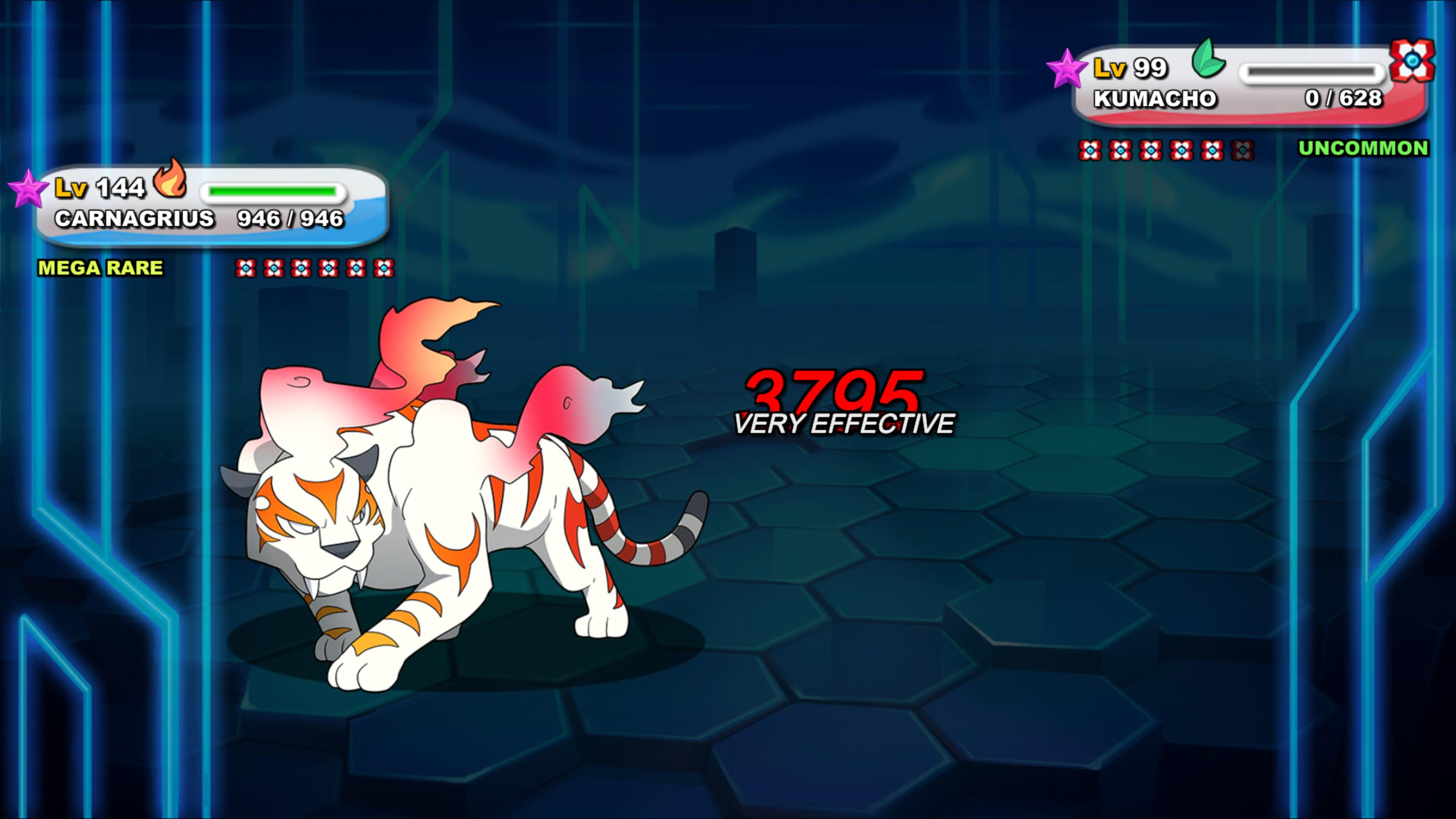
Don’t be deceived, that Nexomon almost 50 levels lower can easily knock out 1/2 or more of my HP in one hit. Weaknesses are no joke and often result in death. Weaknesses are a whole different ball game. As much as I enjoy making cool single or dual type lineups in Pokémon, it’s just a very bad idea here. You will severely disadvantage yourself. Don’t think a big level gap will save you either as attacks hit heavy in this game. Even being 10+ levels above enemy Nexomon, they can easily do massive amounts of damage and be fatal if they catch your weakness. You’ll find yourself swapping often especially because annoyingly enough, swapping IN a Nexomon gives them a free turn, which your enemies capitalize on as often as you do.
I think this game does a great job at making most, if not all Nexomon viable for use. There is no EV/IV tracking like a madman. No nature’s to breed or farm for, and no breeding in moves. They are how they are. A level 20 Nexomon caught and a level 20 raised will be identical. As they evolve, they gain SP for moves, but some of the basic ones can still be useful. Another component that is extremely vital to success is status effects. Status-inflicting attacks are highly misleading in their descriptions because it shows the attack accuracy as very low, but it is actually referencing the status effect chance to land. Confuse is OP, and unlike Pokémon you don’t occasionally make attacks during confusion. Here, you just keep slapping the shit out of yourself over and over. It’s deadly. Poison and Burn are similar, but unlike Confusion, at least you can fight back. Bound and Paralysis are basically the same, and they work wonders for catching weaker Nexomon.

P.S The Wind Starter Is A Beast, but you can easily locate them all From all who played Nexomon One previously on mobile devices, they gave me the impression that it was harder than Extinction. I found it to be the other way around. Extinction really beat the crap out of me at times and I was forced to grind and grind. One, on the other hand, coddled me with levels. In a few hours I went from level 80s, to Reborn Nexomon back at level 5, and back to Reborn Level 99. It was way too easy to do it, and honestly the lack of difficulty is my biggest complaint. The humor was there as well, but you can tell the sequel really went hard with it. There was plenty of laughs and sarcasm in One and looks like fans wanted more.
Nexomon is a solid Pokémon competitor, especially in a time where Monster Rancher is non-existent, Digimon is slowly building back up, and everything in between seems to fade into the crowd. It’s a great choice for those who want to see a different style of creatures, and who find Pokémon lacking the challenge and difficulty.

Atlas always dropping some knowledge bombs
-Game Info-
Nexomon
Genre: Monster Catching/Adventure/RPG
Developer: Vewo Interactive
Publisher: Pqube
Release Date: 7/10/2020 | 9/17/2021
Platforms: PS4/PS5, XB1/XBS S|X, NSW, PC

-GamerDad Info-
Completed On: 10/13/2021
Played On: PS5
Time Played: ~70 Hours
Rating: 6.75/10
- Let’s Talk About It…The Backlog
Face it, we all have at least ONE game that has eluded us
It’s a day like any other. You check out your nearest brick and mortar game shop, whether it be a local mom and pop, Gamestop, or any other well known chain. You’re just there to check stuff out, absolutely nothing will come out of this. Or you are browsing online, apps like Best Buy or Amazon. Just as you ever so innocently were perusing the shopkeepers’ wares…it calls out to you. The Sale. Buy-one-get-god-knows-how-many. You fight it but the willpower is fading away slowly, and The Sale consumes you.
I’m a sucker for a good sale, especially since I’ve been trying to build out a decent physical collection. This is fine until you realize you’ve done this over and over and you have a stack of games that have not been touched yet, or have been played briefly. The dreaded backlog is omniscient and omnipotent.
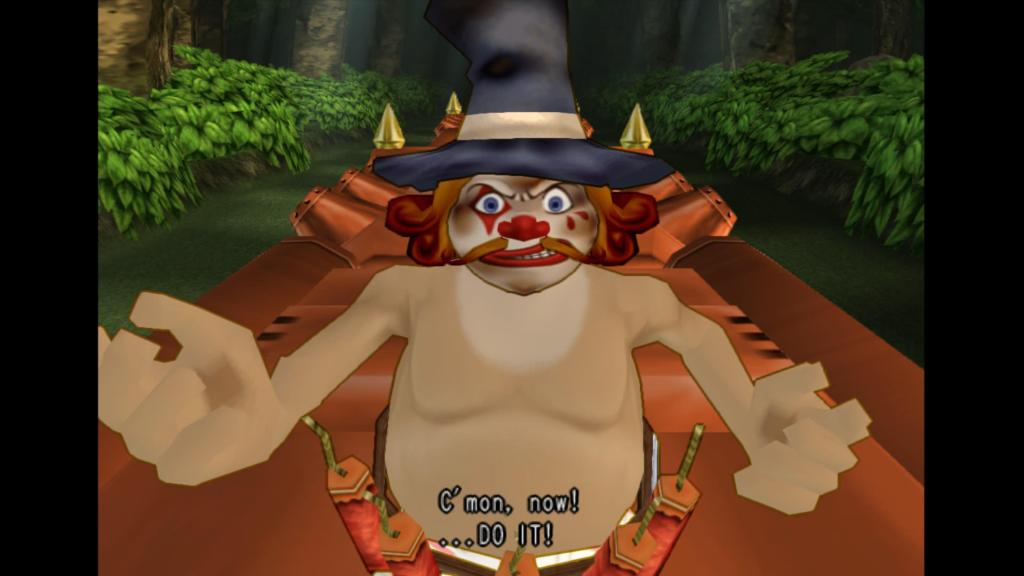
The Backlog Goading Me To Finish It Because It Knows It Will Never Happen. Sigh It becomes so much more difficult to manage it when, let’s admit, there’s just so much out there to play. I can easily think of multiple titles from now till early next year that have been announced and I’m looking forward to. This isn’t even taking into account those games I’ve picked up on those sweet sales I’ve mentioned earlier. The logical solution would just be to avoid buying new games until you’ve played the untouched or unfinished ones. This idea is great on paper, but the dedication to that must be real to avoid anything new, especially moreso for expended periods of time. There are plenty of ways you can go about tackling your list, and while I’m no expert, I can share with you what I’ve personally done to combat it.
Out With An Old, Out With A New
This one is simple enough. Sometimes backlog games tend to be older. I think we tend to be attracted to the newer games as they generally run smoother, look better, and have better QoL features. That’s obviously not the case all the time but let’s just assume to make things easier. So you have your older backlog game…balance it off with a newer game. Ying and Yang. Equilibrium maintained. Recently I completed Hades (excellent game, by the way), and my backlog game? Dynasty Warriors Gundam 3. DWG3 fell into the cesspool of my backlog for years because of a dead online, and slow paced stories that all seemed to barely evolve from where they started. We are talking some serious contrast here: A game that was a smash hit on the switch and has also garnered excellent reviews on the current gen consoles, and a game that released stateside in 2011 using a franchise that I feel has still hasn’t been properly pushed outside of Japan. Hades, as difficult as it was for me, served as my buffer for the monotonous gameplay that has always plagued Musou games.
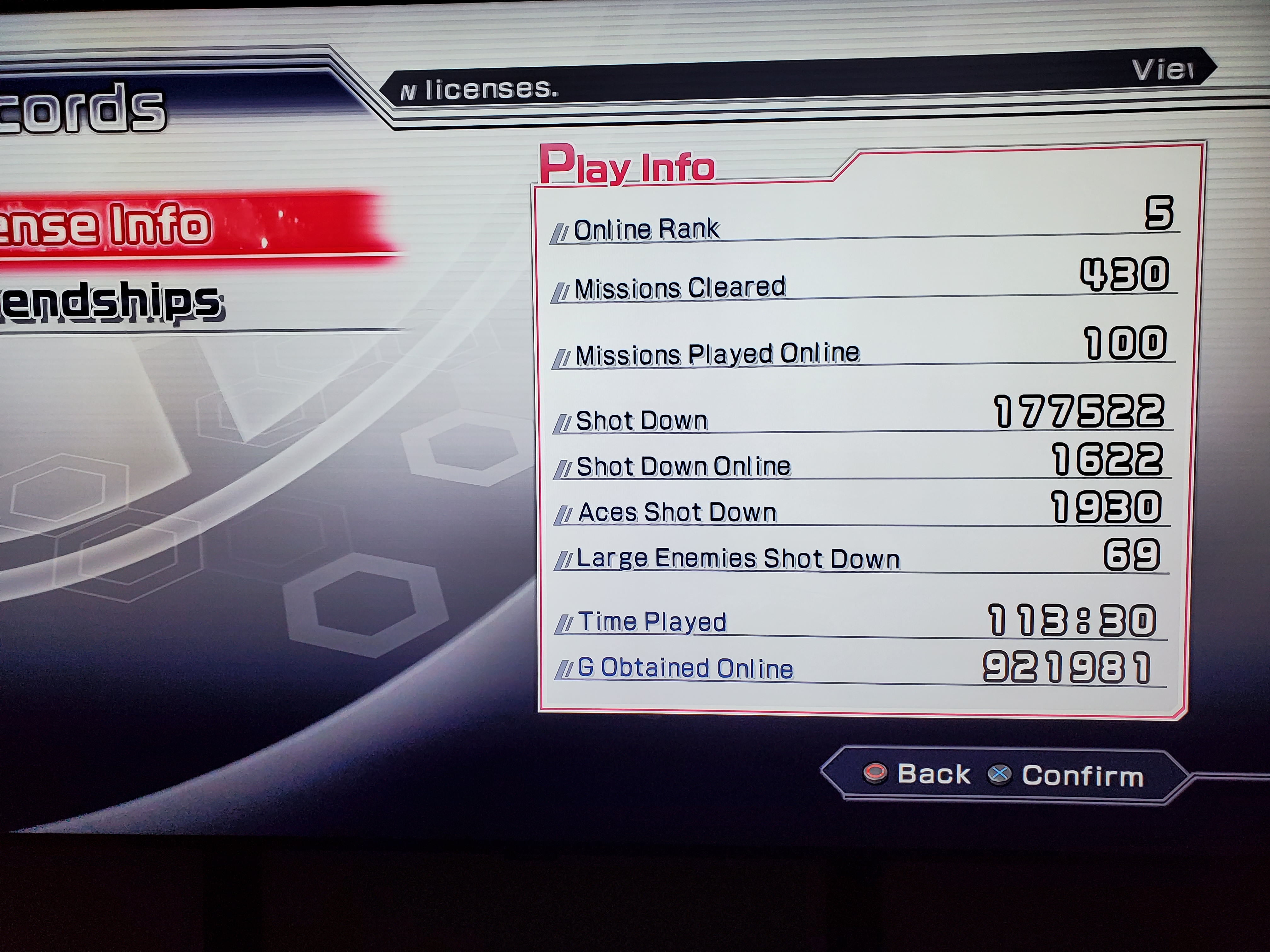
113 Hours, Beginning 9 Years Ago. The Joy To Finish This Was Incredible. Compare And Contrast Same Style/Theme/Genre
Continuing on using the same examples for this, I really enjoy the Gundam franchise and all that it encapsulates: the drama and rivalries, the eclectic cast (seriously..Full Frontal? Where do they get these names from?), and the mobile suits most of all. Hades, to me, was top tier design for its genre and excelled with its character dynamics. I feel like the character banter, relationships and rivalries mirrored DWG3, so I enjoyed seeing how well those dynamics are portrayed and handled in between the time difference of these games. In this instance,, I compared how two vastly different games handled those relationships and character interactions,, because they implemented it in very different ways.
Perhaps playing two similar games might help make it easier. A better comparison would be games that are a similar genre or even franchise. Ys IX Monstrum Nox was a great game, and it finally pushed me to at least boot up Ys VIII Lacrimosa Of Dana. Playing a current gen Final Fantasy and an older, classic title might be a way to help tackle the games by giving yourself the chance to critique them both, see the evolution of the series and how those traditional designs and systems impacted the game in its most recent iterations.
Make It Fun!
This one is currently my go-to backlog strategy, and I’ve had a reasonable amount of success as far as completion. I decided to set small completion goals for myself. I’ve created community votes, checklists, and challenges, all for the sake of adding a bit of fun to tackling some backlog games. Why? Well, sometimes some games are there because you didn’t like it at all, and that’s fine. Remember, as much as I love my collection of digital accolades like platinums, nobody is really going to go out of there way to judge you based off of what you play and why. So if you don’t like a game, don’t play it. However, sometimes giving that game a chance again and you might be quite surprised and thing to yourself, “why the hell didn’t I play this sooner, I love it”.
Right now I’ve given myself an A To Z JRPG Challenge, in which I’m taking some lesser known games from the genre that I own, and finally playing them. That’s a lot of letters, and we all know JRPGs are not known for being the short, hop-in-and-out type of game. I’ve taken plenty of breaks and for some games, just flat out swapped them out. I’m doing it to make reducing my backlog FUN, so the last thing I want to do is make a huge chore out of it. By doing this I’ve played some games that are ‘meh’, some that have been good, and some that completely exceeded my expectations, but I at least make sure I’m having fun while doing so.
Acceptance

If you have a massive backlog like me, this one is crucial. You may need to come to terms with the fact that, the only way you are going to clear your backlog is if you quit your job, sever all social and romantic ties with people, and become a recluse. The sooner you can acknowledge that you don’t need to play every single game, you can then make some important decisions. If you find yourself at this crossroads, take a look at what you own own sort out what you really want to play versus what you you absolutely no intention of even starting. One way to address this is, if you decide you are only going to play 10 out of these 30 games, is to get rid of the other 20. Sell them, delete them, ignore them. If you are collecting games then go ahead and collect, and keep the collecting aspect separate from the completion aspect or you will drive yourself crazy.
As I’ve begun to seriously tackle my backlog, I’ve learned to focus more of a select few big, new games, and just wait for sales for stuff I have only a mild interest in. I’ve been able to clear out some pretty old games that have stagnated in the depths of that hell for years, and some of them felt pretty awesome to finally check off the list. As long as you are having fun doing it, don’t beat yourself up over it too much. Worst case scenario, you can do what I plan on doing, and pawn off all the unfinished games to my kids on my deathbed. “Go forth, children, uphold my honor”.
- Tales Of Arise | Game Review
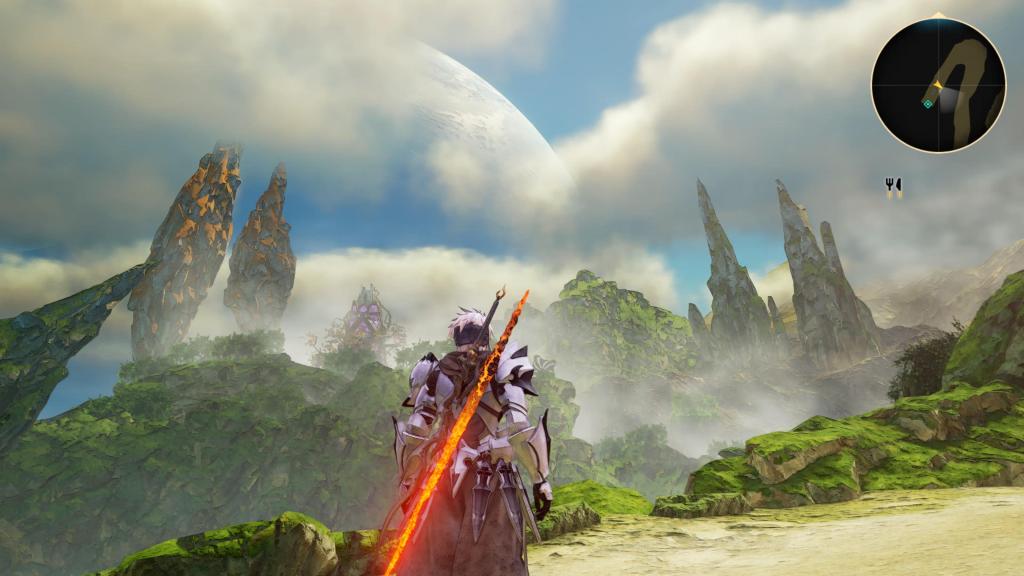
My first true experience with the Tales series did not disappoint at all. Tales Of Arise was a wonderful story filled with dualities, dark themes and topics, but dressed and polished in one of the most gorgeous JRPGs to date. An easy contender for GOTY.
I really tried to hold off on getting Arise as much as possible. In fact, I wasn’t even going to get it until it was on a deep sale. Reason being is that my experience with the Tales franchise is almost 0. I briefly played Berseria years back (less than 15 hours in so for a Tales game I barely finished the Tutorial!), but fell out of the game as I picked up others and it plunged into the Abyss of the Backlog. Thanks to constant bombardment of excitement from my fellow gamers on Instagram, I caved, and went for it. So glad I made that call.
It wouldn’t be a JRPG without some sort of love interests intertwined in this web of conflict and deception, and Alphen and Shionne are so masterfully done you feel like you are the wingman whenever they finally break down each other’s barriers and discover each others true selves. While their tense relationship is a part of the story, the true takeaway from it is how these two different people have grown to understand one another, and once those barriers are down, they realize how much they actually have in common. Each duo has a dynamic that gets fleshed out towards the end, and the group as a whole is a small example of the world they are striving to build a future for; a world where people aren’t discriminated due to their Astral aptitude, race, magical affinities, social standing, or ruled unfairly and unjustly.
All the flair and beautiful chaos of the Boost Attacks and Mystic Artes never gets old Combat was a thrill! I really cannot stress how excellent it is when combat mechanics are so crisp and concise that after time even I, Tales amateur, was able to feel like an Artes Master. You can’t just sit idle in here and mash buttons. There is a clearly emphasis on timing, whether it be parties, dodges, and performing Boost Strikes at the right time. Dohalim can root an enemy down, while Law will stun armored foes, allowing you to make quick work of them. The genius part is being able to utilize the Boost Strikes even if the character is not in your current party, so you can play with the crew you like and still reap the benefits of the backup when you need it. Oh yes Kisara, swoop in and save me with your nice, perfectly contoured…shield. Plenty of Artes and abilities can be learned as you gain Titles, which unlock as you complete story quests or fulfill a certain requirement. As you master combat, it just becomes so fluid and second nature. I occasionally played as other characters, but Alphen just became almost poetic with how easy it was to string combos, dodge, parry, and weave tapestries of death with how balanced he was with the sword. Let me collect myself and let’s get down to the juicy stuff.
So, banging opening theme aside, Arise starts out dark. Slavery, oppression, the marginalized vs the elite. It’s clear I’ve stepped into a world that after 300 years of subjugation, they have given up hope. As the nameless hero, Iron Mask, I find myself unwittingly embroiled in a story that is out of this world. Literally. But for all the right reasons though! The game has been out for a month, so bear in mind the review here will contain…
SPOILERS ahead.
Voice acting is so well done you don’t need to see Iron Mask/Alphen’s face to truly feel the depth and emotion when he goes off. The world of Dahna has been taken over by the technologically superior Renan invaders stationed on the artificial moon called Lenegis. Each region of Dahna has been broken down essentially by element, with a Lord at the helm. Lords are highly competitive, and upon selection are chosen to participate in what’s called the Crown Contest. This event is what determines who the ruler of the Renan people, the Sovereign, is. Each Lord is in possession of a Master Core, in which they absorb Astral energy of that particular element. Calaglia, for example, is a scorched and flame-ridden region, and Lord Balseph embodies the Fire Master Core.
While initially, the slave labor is thought to be used for mining resources from the planet (metals, etc), upon some revelations later it is determined that the actual resource being gathered is the Astral energy from the Dahnan people themselves. Woah. As if a life of servitude wasn’t enough, the energy that is their very essence is being collected to empower the Lord for what seems like a #$%^ measuring contest. However, Arise has plenty of “wut just happened” moments, so even this is not quite what it seems. Another revelation takes place in Elde Menancia, where it is discovered that a fruit is being given to the Dahnans there which heightens the output of Astral energy, exponentially increasing the rate at which it is harvested. The downside is that it essentially vaporizes the person into nothingness, a silver, featureless liquid.
These scenes with Dohalim are the best of his character arc I mentioned duality earlier and there’s good reason for it. Throughout the game you see two sides of the coin, there’s the marginalized and the superior. Dahnans enslaved by Renans. The Light Astral Energy of Dahna and the Dark Astral Energy possessed by the people of Rena. Dahna is a slave out of necessity. After going on the grandeur sci-fi escapade to Lenegis so much is finally revealed and it’s just Funkmaster Flex bomb drop after bomb drop. Everything has been a lie, all fabricated to bring back the planet Rena, which is basically an empty husk. To do so, they need to basically absorb and merge with Dahna, which would cause certain annihilation. Renans aren’t even truly Renans, they are Dahnans that have been altered, and the Sovereign is another farce. Nothing persists on the surface of Rena, so the people on Lenegis have been blindly following a shadow operation attempting to revive a dead planet by manipulating the Renans, who in turn enslave the Dahnans. All the while everyone is ignorant to the truth, that basically they are being enslaved by their own people, and with each truth that the game sheds, it hits a little bit harder. So many have fought and died for lies, and so many Renans have exerted superiority that is nothing but a lie as well.
When you need a moment to process all the WTF moments that have been dropped recently Let’s get down to my problems with the game. I, like many I’ve discussed Arise with, found the 2nd half a bit disjointed and almost a bit rushed. I feel like there were some big things dropped and the character reactions didn’t quite match the event. The revelation with the true nature of Renans was huge, and the most we could say is “I guess they got it bad too huh?”. It just felt like ignorance was an acceptable excuse for centuries of atrocity. Post-game was relatively small, there were some extra dungeons which featured characters and dialogue referencing older games, so I was pretty clueless, but they were nice challenges. One of the biggest let downs was the lack of a photo mode. You don’t make a beautiful game and then not let me take 14gb worth of carefully manicured photos, thank you very much. The final offender was the constant DLC push. For a single player game, it was always in your face every time you went to camp. Sure the camp menu was a bit sparse, but it was supposed to be a way to unwind from the journey, not a way to push me to buy a swimsuit package and see Dohalim in a Speedo. It just felt disingenuous. I don’t mind buying DLCs and supporting great games, but I don’t need to be handheld to do it like a clueless child.
-Game Info-
Tales Of Arise
Genre: ARPG/JRPG
Developer: Bandai Namco
Publisher: Bandai Namco
Release Date: 9/9/2021
Platforms: PS4/PS5, XB1/XBS S|X, PC

-GamerDad Info-
Completed On: 9/23/2021
Played On: PS5
Time Played: ~70 Hours
Rating: 9/10
- The Allure Of The ‘Average’ And ‘Alright’ – Give ‘OK’ Games A Chance, Too
For the most part, we all love the blockbuster hits and games that deliver superb quality, so why do we spend time with the ones that don’t?
Chances are if you’ve been gaming even a little bit, you will easily become familiar with the names of game franchises that are known for quality, excellence, and fun. While some people can debate the subjectivity of fun, I think quality is a little more cut and dry. You can tell a polished game from one filled with stiff controls, janky gameplay, obtuse designs and an overall product that just seems to lack any cohesion. So why do we subject ourselves to these games if they don’t quite add up?
Before I get into this discussion, I would like to voluntarily throw my hands up and admit that I am extremely guilty of this. Some people can spot something in a game a mile away; whether it be a feature, design choice, graphics, etc, and they will decide then and there at that moment that the game is not for them. End of discussion. But I do my best to look at games as a puzzle, each piece being a different component of the game itself. You can be missing a few pieces, but ultimately, you can see the image or whatever the final product is. Combat might be a slog, but the writing could be excellent, or vice versa. Perhaps the game touches on some excellent themes, but the characters and their interactions and dialogue seem jarring and out of context. It’s also worth noting that these ‘pieces’ of the game are not always equal.

I am not Setsuna, that girl is Setsuna. It should be called She Is Setsuna? I’ve played plenty of games and there’s quite a decent amount that aren’t the run of the mill AAA experience or polished as well as they could be. If I’m interested in it, I’ll find a way to take each aspect of the title for what it’s worth, and then at the end, reassess the game. I’ve found a number of titles that some parts are solid, while others are just not quite as strong. I’m not saying they are awful or unplayable messes (which those games certainly do exist), but they are more of a double-edged sword in terms of good and bad. The latest example is a title I am currently playing, I Am Setsuna. An ode to retro JRPGs, I Am Setsuna seems to embody the look and feel of the JRPGs of yesteryear, without the substance and charm. But I take a step back and analyze the world within the confines of the game, and it’s a morose, dreary place (so far, at least), so I can see why it lacks flair. In fact, I find the somber ambience intriguing as I’m curious to uncover the apparent plot twist that is seemingly within my grasp.
Two more examples are Crystar and Death end re;Quest. Both games are similar in that they are clearly AA JRPGs and it shows, I feel each has its strengths and weaknesses, despite the overall product being just OK in my opinion. Death end re;Quest had pretty good writing and did a good job worldbuilding, despite the world and story being somewhat convoluted. Crystar on the other hand, I felt like the writing was lazy, and it did nothing to improve the already lackluster characters and their typical tropes. While they both felt stiff and bland in their combat and super generic dungeon designs, Crystar was better at showing the growth (and alternate twists) that characters experienced by the end, Death end re;Quest seemed to hope you liked the characters as they were, and they rarely broke away from their tropes for growth or improvement. In the end though, neither could be saved from its okay-ness. Are they bad games? No, far from it. I enjoyed my time with each, and they both touched on some good themes, and had some decent music to boot. It just seems like the general consensus is either games are great like TLOU or they are God awful, and the grey area is becoming increasingly thinner.
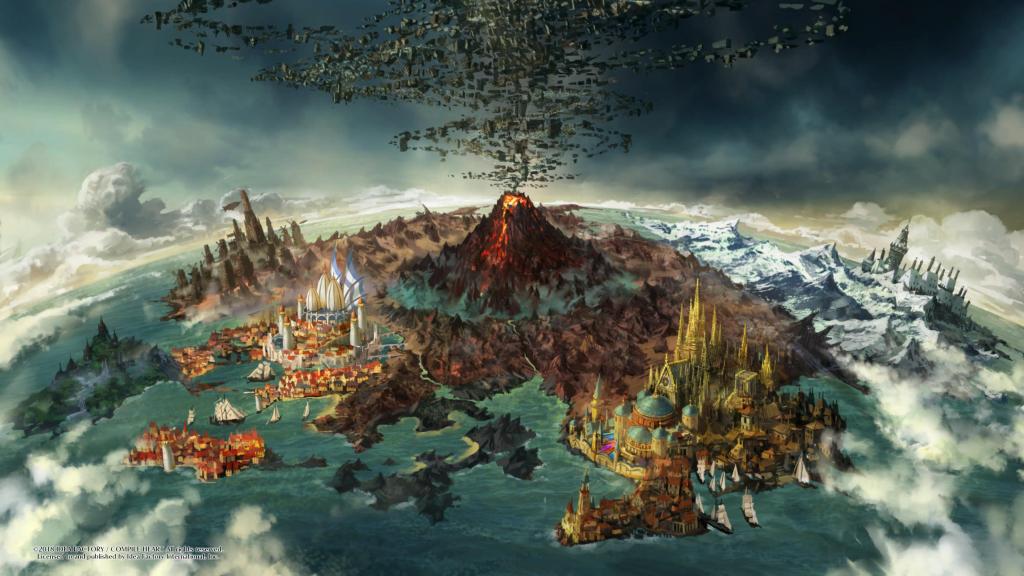
What a mysterious, grand looking world in Death end re;Quest, a shame it’s only a gilded veneer and it wears off quick. What’s the point then? Well, the bottom line is…play what you want! Not every game is going to have a GTA V budget (×3, damn you Rockstar Games), not every racer is going to be GT/NFS/Forza, not every PS Exclusive is going to be God Of War or TLOU2, and not every RPG is going to be Final Fantasy or Skyrim. There are a plethora of games out there that are good in some ways, and that are simply just fun but easily get overshadowed.
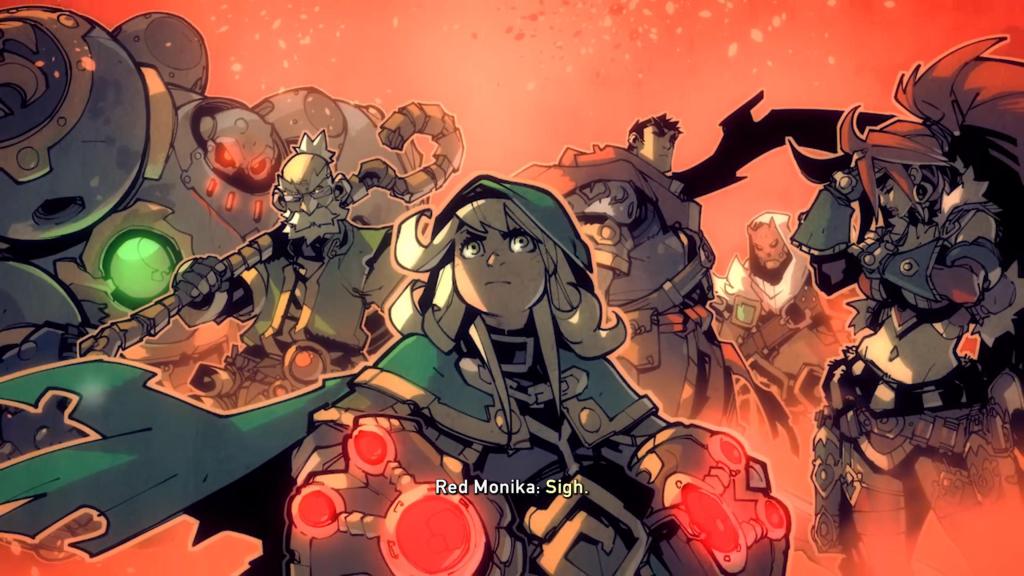
Such a rag tag cast in Battlechasers: Nightwar but it worked so well. Sequel please? Battlechasers: Nightwar was AWESOME, and if you asked me a year ago what the hell a Battlechasers was I wouldn’t said I don’t know what on earth that is. Did it do anything new and inventive? No, not really, but it was just a solid game and it was fun to play. And if you are having fun, then screw what the person next to you thinks. But I say if you have the patience and time, give some new games a chance, you’d be surprised at what you may end up enjoying.
Game on.
 Level One Gamer Dad Plays